poczta@prometalform.eu
+48 95 762 08 61
+48 95 762 08 61
Modern technologies of metal working
Laser beam cutting
Laser cutting of tubes and sections
Robotic welding
Sheet metal bending
+48 95 762 08 61
Laser beam cutting
Laser cutting of tubes and sections
Robotic welding
Sheet metal bending
Imagine a metal rod transforming into a complex car body component, or a flat sheet of metal becoming a perfectly shaped tube. This is the magic of metal forming — a technology that has been revolutionizing industry for decades and makes it possible to create objects without which it is hard to imagine the modern world.
Metal forming is a process in which the shape of a material is changed by applying appropriate pressure, leading to permanent, controlled deformations. Unlike machining, where material is removed in the form of chips, here not a single gram of valuable raw material is lost — the metal simply takes on a new form. It is like sculpting, but instead of removing excess material, the entire piece is transformed into the desired shape.
The key to understanding this technology lies in the concept of metal plasticity — the ability of metals to undergo permanent deformation under stress. When the applied force exceeds the material’s yield strength, atoms in the crystal structure shift relative to one another, creating a new, stable arrangement. This property, especially pronounced at elevated temperatures, allows metals to be shaped into almost any form.
Forging is one of the oldest metalworking techniques known to humanity, with roots dating back to antiquity. Today, this process has evolved from the blacksmith’s hammer to advanced hydraulic presses capable of exerting thousands of tons of force.
Hot forging involves heating the metal to a temperature at which its plasticity increases dramatically. Steel can be forged at temperatures of around 1200°C, allowing even massive components to be shaped freely. This method is indispensable in the production of engine crankshafts, gears, and bridge structural elements — wherever extreme strength and reliability are required.
Cold forging is carried out at room temperature or slightly elevated temperatures. Although it requires higher forces, it delivers better surface quality and more precise dimensions. It is an ideal solution for smaller components such as bolts, fasteners, and connectors.
Rolling is a process in which metal flows between rotating rolls, gradually taking on the desired shape and thickness. This is the technology responsible for producing most sheet metal, steel profiles, and railway rails worldwide.
In hot rolling, the material is heated above its recrystallization temperature, enabling significant thickness reductions with relatively low forces. This makes it possible to transform massive steel ingots several dozen centimeters thick into thin sheets.
Cold rolling is used as a finishing process to achieve excellent surface quality, precise dimensions, and favorable mechanical properties. Cold-rolled sheets are characterized by higher hardness and tensile strength.
Stamping is a technique particularly valued in the automotive industry. It allows flat sheet metal to be transformed into spatial components with complex shapes — from car doors and hoods to small trim elements.
Deep drawing makes it possible to produce parts whose depth significantly exceeds the dimensions of the initial opening. Beverage cans, sinks, faucet bodies, and electronic housings are all made using this method. The process requires precise parameter selection — too much force can cause cracking, while too little will not achieve the desired shape.
Blanking and punching involve cutting sheet metal along defined contours, often combined with simultaneous forming. A single operation can cut and shape a part, significantly accelerating production.
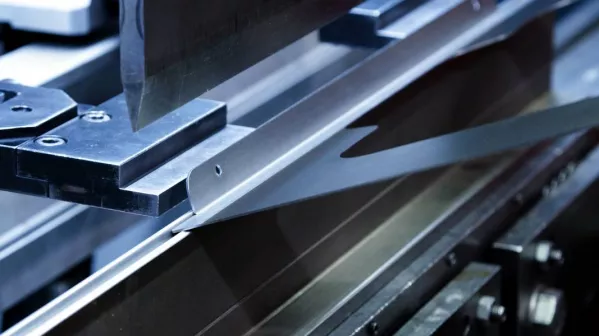
Bending is a process that, although seemingly simple, requires considerable technical knowledge. Every metal has its characteristic “memory” — after unloading, it partially returns to its original shape (the phenomenon of springback). That is why experienced technologists must account for this effect by overbending the part by an appropriate angle.
Modern CNC press brakes can perform sequences of dozens of bends with accuracy down to fractions of a degree, creating complex profiles used in construction, furniture manufacturing, and machine structures. Robotization of this process ensures not only precision but also repeatability — every part in the series is identical.
Extrusion resembles squeezing toothpaste from a tube — metal is forced through an opening in a die, taking on its shape. This method allows profiles with almost any, but constant, cross-section to be produced: from simple tubes to advanced shapes with multiple ribs and chambers.
Aluminum extrusion is particularly efficient due to the material’s lightness and plasticity. Thanks to this technology, window frames, façade profiles, heat sinks, and lightweight structural systems are produced. The process can be carried out hot (for greater deformation) or cold (for better surface quality).
From the smallest fastening pin to large body components — metal forming is at the heart of automotive production. Wheels, pistons, crankshafts, bearings, body panels, and springs are all products of various metal forming techniques.
In an industry where every gram matters and strength is a matter of life and death, metal forming enables the creation of components with optimal designs. Forged turbine blades, extruded fuselage profiles, and stamped structural elements cannot be replaced by other manufacturing methods.
Steel structural profiles, beams, sections, trapezoidal sheets, and façade elements are all produced through rolling, bending, and profiling. Metal forming ensures optimal strength parameters with minimal material consumption.
Device housings, heat sinks, connectors, conductors, and shields — this entire range of products requires precise stamping and bending of thin sheets as well as profile drawing.
Washing machines, refrigerators, food cans, and aluminum bottles — all are products of deep drawing and extrusion. The ability to quickly produce large series at low cost makes these technologies indispensable.
In times of rising raw material prices and growing environmental awareness, the ability to use nearly 100% of the material is a huge advantage. The absence of waste in the form of chips means savings and a smaller carbon footprint.
During metal forming, strain hardening occurs — the metal becomes harder and stronger. Additionally, the process does not interrupt material continuity (no chips or gaps), eliminating stress concentrators. Forged components often withstand up to twice the load of their cast or welded counterparts.
Modern technologies such as CNC bending or stamping on advanced servo-electric presses allow accuracy down to hundredths of a millimeter. Moreover, every subsequent part in the series is identical — a key feature in mass production.
A single press cycle can take fractions of a second, and rolling mills produce hundreds of meters of sheet metal per minute. Such efficiency is unattainable for other processing methods.
From microscopic electronic components fractions of a millimeter thick to multi-meter structural elements — the range of possibilities offered by metal forming is virtually unlimited. Equally broad is the choice of materials: from delicate aluminum, through structural steel, to exotic titanium alloys.
In many cases, a part after metal forming requires no additional finishing. Surfaces are smooth and free of machining marks, which shortens production time and reduces costs.
Metal forming is not standing still. Development is moving toward even greater precision, automation, and intelligent process management. Systems using artificial intelligence can analyze process parameters in real time and adjust them, ensuring optimal results.
New materials — superalloys, metal composites, and materials with gradient properties — pose new challenges for engineers but also open up fascinating opportunities. Techniques such as isothermal forging or asymmetric rolling make it possible to obtain structures unattainable by traditional methods.
Sustainable development is becoming a priority — modern plants use renewable energy, recover process heat, minimize water consumption, and eliminate emissions. Metal forming, with its inherent material efficiency, fits perfectly into the philosophy of a circular economy.
Metal forming is a technology that combines traditional craftsmanship with the most advanced engineering. It is a field where physics meets engineering, and theoretical knowledge of material structures translates into real, functional products. From ancient blacksmiths to modern robotic production lines — the journey has been long, but the goal remains the same: to transform raw metal into something useful, durable, and excellent.
At Pro Metal Form, we understand that behind every component there is not only a machine, but above all knowledge, experience, and passion. That is why we combine the best technologies with an individual approach to every project, delivering the highest-quality products that serve reliably for years.