poczta@prometalform.eu
+48 95 762 08 61
+48 95 762 08 61
Modern technologies of metal working
Laser beam cutting
Laser cutting of tubes and sections
Robotic welding
Sheet metal bending
+48 95 762 08 61

Laser beam cutting
Laser cutting of tubes and sections
Robotic welding
Sheet metal bending
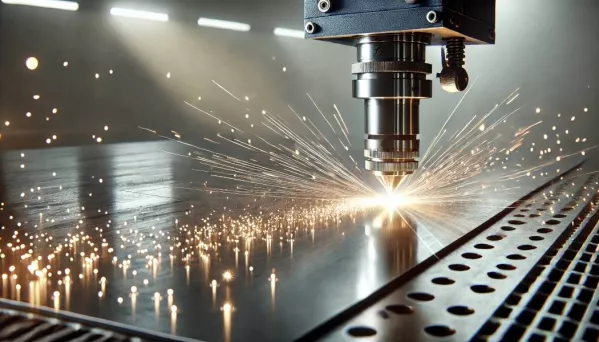
Laser cutting is a complex thermal process in which a concentrated beam of laser radiation interacts with material, causing localized melting and, in some cases, vaporization. Understanding the physical phenomena accompanying this process is crucial for optimizing processing parameters and achieving high-quality cuts. This article discusses the fundamental physical mechanisms occurring during laser cutting, with particular emphasis on material phase processes, kerf formation, and thermal phenomena in the processing zone.
The laser cutting process begins with the absorption of electromagnetic radiation energy by the workpiece material. The efficiency of this process depends on the absorption coefficient, which is a function of the laser radiation wavelength and the optical properties of the material. For metals in the infrared range, typical for CO₂ lasers (λ = 10.6 μm) and fiber lasers (λ ≈ 1.06 μm), absorption at room temperature is relatively low, ranging around 2-5% for steel with CO₂ radiation and 10-15% for fiber lasers.
Increasing material temperature leads to a significant increase in the absorption coefficient, creating positive feedback - rising temperature increases absorption, which in turn accelerates further heating. This process can be described by the heat conduction equation with a source term representing absorbed laser power.
Upon reaching the material's melting temperature, the solid-liquid phase transition begins. The melting front advances into the material at a rate dependent on laser power density, the material's thermophysical properties, and heat dissipation conditions. The molten zone is characterized by thermal and capillary convection induced by temperature gradients and surface tension.
The energy balance in the melting zone accounts for heat supplied by the laser beam, latent heat of fusion, losses through conduction into the material, and removal of molten material by the working gas. For low-carbon steel, the latent heat of fusion is approximately 247 kJ/kg, representing a significant portion of the process's total energy requirement.
At sufficiently high laser power density, the temperature at the beam center can exceed the material's boiling point, initiating intense vaporization. For steel, this temperature is approximately 2862°C at atmospheric pressure. Material vaporization is a strongly endothermic process - the latent heat of vaporization for steel is approximately 6090 kJ/kg, over 20 times greater than the latent heat of fusion.
Saturated vapor pressure increases exponentially with temperature according to the Clausius-Clapeyron equation. In areas of highest temperature, vapor pressure can reach values from tens to hundreds of kilopascals, creating a recoil pressure effect. This force acts on the liquid metal surface, influencing the shape of the melting front and the dynamics of molten material removal.
Intense vaporization creates a plasma layer above the material surface, particularly during cutting of metallic materials at high powers. This plasma can partially absorb and scatter laser radiation, reducing the effective power reaching the material - a phenomenon called plasma shielding.
The cutting kerf arises from material removal from the laser beam interaction area and is characterized by specific three-dimensional geometry. Kerf width at the top of the material is typically greater than at the bottom, resulting from power density distribution in the laser beam and energy absorption and scattering processes during material penetration.
Typical kerf width when cutting with a fiber laser ranges from 0.1 to 0.4 mm depending on material thickness and beam diameter. For a Gaussian beam, kerf width at the material's upper surface approximately equals the focal spot diameter increased by a coefficient accounting for thermal melting.
The cutting front - the surface separating molten material from solid material - is characterized by complex geometry dependent on beam movement direction, cutting speed, and material properties. In steady-state motion, this front forms an inclined surface whose angle relative to the beam direction increases with cutting speed.
Temperature distribution on the cutting front is not uniform. The highest temperature occurs in the upper part of the kerf, where the laser beam enters the material. As it penetrates deeper, energy is absorbed and scattered, leading to temperature reduction in the lower part of the kerf. This temperature gradient directly affects molten metal viscosity and its removal efficiency.
Molten material removal from the kerf occurs primarily through the action of the working gas stream flowing along the cutting front. This mechanism can be divided into several components: aerodynamic forces exerted by the gas stream, pressure gradient along the kerf, gravitational forces, and vapor recoil pressure.
For oxygen cutting, an additional exothermic oxidation reaction occurs, supplying a significant amount of additional energy - the enthalpy of iron oxidation is approximately 6.68 MJ/kg, which can constitute 50-70% of the process's total energy balance. Iron oxide is characterized by lower melting temperature (approximately 1377°C for FeO) and viscosity than pure metal, facilitating its removal from the kerf.
In the case of cutting with inert gas (nitrogen, argon), the process is purely physical, based on melting and material removal without chemical reaction assistance. This requires higher laser powers but ensures cutting edges free from oxide layer.
Various forms of process instabilities can occur during kerf formation. Capillary instability of molten metal, induced by surface tension and gas pressure fluctuations, leads to irregular material removal and striations on the cut surface. The frequency of these striations correlates with cutting speed and gas flow parameters.
Thermal instability associated with fluctuations in laser energy absorption can cause local variations in kerf width and surface roughness. This phenomenon is particularly visible when cutting at speeds close to maximum for a given process configuration.
Dross is solidified material adhering to the lower edge of the cutting kerf, formed when molten metal is not completely removed by the working gas stream. Its formation mechanism is related to the balance of forces acting on molten metal in the lower part of the kerf: aerodynamic forces from the working gas, surface tension of liquid metal, gravitational forces, and adhesion forces to the material edge.
In the lower part of the kerf, where laser energy is partially depleted, molten metal temperature is lower, leading to increased viscosity. Simultaneously, gas stream velocity decreases due to pressure losses and flow channel expansion. These factors favor molten material accumulation at the lower edge.
Several types of dross can be distinguished, differing in morphology and formation mechanism. Adherent dross forms when molten metal wets the cutting edge and solidifies, creating a continuous layer with thickness from tens to hundreds of micrometers. It is difficult to remove and often requires additional mechanical processing.
Globular dross consists of small spheres of solidified metal loosely adhering to the lower edge. It forms when the gas stream causes atomization of molten metal, and the resulting droplets solidify before complete removal from the kerf. This type of dross is usually easier to remove than adherent dross.
Working gas pressure and type have a fundamental impact on dross formation. Higher pressure increases aerodynamic forces removing molten metal, reducing the tendency for dross formation. However, excessive pressure can lead to turbulence in the cutting zone and deterioration of side surface quality.
Cutting speed affects molten metal residence time in the kerf and molten layer thickness. At excessive speed, this time may be insufficient for effective material removal, particularly from the lower part of the kerf. On the other hand, too low speed leads to excessive heating and increased molten metal volume.
Laser beam focus position relative to the material surface determines power density distribution along material thickness. Focus placed slightly below the upper surface (typically 1/3 of material thickness) provides optimal compromise between effective melting in the lower part of the kerf and process stability in the upper part.
Optimization of gas flow parameters is crucial for dross control. Use of high-purity gas (particularly nitrogen ≥99.995%) prevents molten metal oxidation and reduces its viscosity. Gas nozzle design should ensure laminar, well-collimated gas jets coaxial with the laser beam.
Pulsed modulation of laser power or gas pressure can improve molten material removal dynamics. Pulses at frequencies of 100-1000 Hz induce periodic pressure and temperature fluctuations that can break surface tension and facilitate material ejection from the kerf.
Dual gas stream cutting technique, where an additional stream is directed from the material's lower side, can significantly reduce dross when cutting thick materials. However, this requires special tooling and is mainly used in applications requiring the highest quality.
The heat-affected zone (HAZ) is a material area that has not melted but has been heated to a temperature causing microstructure and mechanical property changes. HAZ width in laser cutting is typically much smaller than in conventional thermal methods, usually from 0.05 to 0.5 mm, which is one of the main advantages of this technology.
Temperature distribution in the HAZ can be described by solving the heat conduction equation with a moving source. For laser cutting, Gaussian source models or multidimensional volumetric source models are most appropriate. Maximum temperature in the HAZ occurs directly at the kerf edge and decreases exponentially with distance.
In carbon and low-alloy steels, the HAZ is characterized by the presence of various microstructural zones depending on peak temperature achieved. Directly at the cutting edge, in the area heated above the austenitization temperature (approximately 727-912°C for steel), transformation of the initial structure to austenite occurs.
At cooling rates typical for laser cutting (10² to 10⁴ K/s), austenite transforms into hardening structures: martensite, bainite, or a mixture of both, depending on the steel's chemical composition and local cooling rate. Martensite is characterized by high hardness (up to 600-800 HV for high-carbon steels), but also increased brittleness and susceptibility to cracking.
Further from the cutting edge, in areas heated below the austenitization temperature but above approximately 400-500°C, tempering processes of previously existing hardening structures or changes in precipitation distribution occur, leading to local changes in hardness and mechanical properties.
The thermal cycle of laser cutting induces a complex residual stress state in the material. During heating, material in the HAZ tends to thermally expand but is constrained by the surrounding cold material, leading to compressive stresses. During cooling, the situation reverses - material contraction is opposed by the surroundings, generating tensile stresses.
The final residual stress state after cutting is typically characterized by tensile stresses in the HAZ, reaching values from 50% to 100% of the material's yield strength. These stresses can initiate cracking, particularly in materials with low ductility or in the presence of stress concentrators.
Residual stress distribution is non-uniform both along kerf depth and in the direction perpendicular to the cutting edge. Gradient stress distributions can lead to deformation of thin-walled elements after separation from base material.
Reducing HAZ width requires minimizing total heat input to the material while maintaining process stability. This can be achieved by increasing laser power density through reducing beam diameter at focus. Modern systems with fiber lasers of high beam quality (M² < 1.1) enable achieving focal spot diameters below 50 μm.
Increasing cutting speed reduces thermal interaction time on each material volume element, leading to narrower HAZ. However, there is an upper speed limit resulting from melting and material removal process dynamics. Optimal speed is a function of laser power, material thickness, and quality requirements.
Multi-pass cutting technique, where successive passes remove material in stages, can reduce HAZ by dispersing heat input in time and space. However, this method is less efficient and mainly used in special applications.
Application of assisted cooling, where a coolant stream (water, emulsion) is directed at the cutting edge from the side opposite the laser beam, can significantly increase cooling rate and reduce HAZ width. This requires special coolant delivery systems and is limited by the possibility of quench cracking at extremely rapid cooling.
For hardenable steels, preheating the material to 100-300°C can be applied, which reduces cooling rate and prevents formation of high-hardness martensitic structures. Heating can be accomplished by an additional heat source (induction, resistance) or defocused laser beam in a pass preceding cutting.
Modification of steel chemical composition, particularly reduction of carbon content and alloying additions increasing hardenability, limits the tendency for hardening structure formation in HAZ. Use of low-carbon steels (C < 0.1%) or ferritic steels minimizes structural changes in HAZ.
Post-cutting heat treatment, such as tempering at 150-650°C, can reduce residual stresses and improve ductility of hardening structures in HAZ. Tempering temperature and time are selected based on steel chemical composition and required final properties.
Physical phenomena occurring during laser cutting constitute a complex system of coupled thermal, phase, and hydrodynamic processes. Material melting and vaporization mechanisms determine process energetics and require precise control of laser power density and interaction time. Kerf formation results from dynamic equilibrium between energy supply, material melting, and its removal by the working gas stream.
Dross formation represents one of the main technological challenges, requiring optimization of gas flow parameters and process thermophysical properties. Heat-affected zone minimization is crucial for preserving material mechanical properties and requires a balanced approach considering both laser beam parameters and cutting process dynamics.
Deep understanding of these phenomena enables conscious design of laser cutting processes, optimization of technological parameters, and development of new processing strategies ensuring high quality and repeatability with minimal impact on base material properties.