poczta@prometalform.eu
+48 95 762 08 61
+48 95 762 08 61
Modern technologies of metal working
Laser beam cutting
Laser cutting of tubes and sections
Robotic welding
Sheet metal bending
+48 95 762 08 61

Laser beam cutting
Laser cutting of tubes and sections
Robotic welding
Sheet metal bending
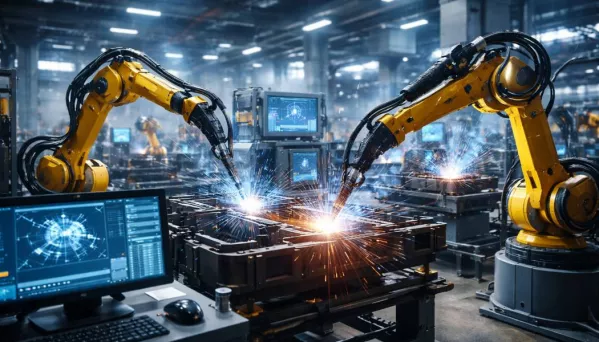
When the first welding robots appeared on production floors in the 1980s, many experts treated them as a technological curiosity. Today, robotic welding forms the foundation of modern manufacturing, and its evolution is gaining momentum that seemed unattainable just a decade ago. But what we've seen so far is merely a foretaste of the real revolution.
The most groundbreaking change in the coming years will be the integration of advanced artificial intelligence with welding systems. Current robots execute programmed movement sequences with impressive precision, but future systems will think autonomously. Imagine a robot that not only welds according to parameters but also:
Analyzes weld quality in real-time and independently corrects current, voltage, or speed parameters. Recognizes material defects before starting work and adapts welding techniques to specific conditions. Learns from each welded joint, building a knowledge base of optimal strategies for different materials and geometries.
Artificial intelligence will transform welding robots from tools into production partners, capable of making decisions at the level of an experienced welding master.
The sensor revolution has already begun. Future welding robots will be equipped with perception systems that surpass human capabilities. Thermal imaging cameras will monitor heat distribution in welded material with accuracy down to individual degrees, preventing overheating or uneven cooling. Laser spectrometers will analyze the chemical composition of the weld pool in milliseconds, detecting the slightest deviations from standards. Ultrasonic inspection systems will scan welds immediately after completion, identifying internal cracks or pores invisible to the naked eye.
This multidimensional perception means that quality control will no longer be a separate process following welding, but an integral part of welding itself. Defects will be detected and corrected at the moment of their formation.
One of the biggest myths about robotization is the belief that machines will completely replace humans. The future looks different. Emerging collaborative welding robot systems (cobots) will be designed for direct cooperation with humans, leveraging the strengths of both. Humans bring flexibility of thought, the ability to solve unusual problems, and intuition developed through years of experience. Robots bring unchanging precision, resistance to fatigue, and the ability to work in hazardous conditions.
In practice, this might mean a welder who prepares difficult joints and determines the welding strategy, while a cobot executes monotonous, repetitive sequences. Or a team where a human welds in hard-to-reach places while a robot simultaneously executes main welds on the same structure.
Advanced gesture interfaces and augmented reality systems will allow welders to "lead" robots intuitively, like experienced dancers leading their partners.
Until now, most welding robots have been massive machines bolted to production hall floors. The future will bring a mobility revolution. Autonomous mobile robots will move around construction sites, shipyards, or energy infrastructure, independently finding locations requiring welding. Welding drones will service hard-to-reach structures, bridges, or wind turbines, eliminating risk for people working at heights. Underwater welding robots will perform repairs on drilling platforms or pipelines without the need for costly and dangerous diving.
This mobility will radically expand the applications of robotic welding beyond the traditional production environment, encompassing infrastructure construction, mining, and energy industries.
Material evolution drives welding evolution. As industry shifts toward advanced composites, high-strength alloys, and nanomaterials, robotic welding systems will need to keep pace. Next-generation laser welding will enable joining of materials previously considered unweldable. Hybrid joining methods will combine traditional welding with additive manufacturing techniques, enabling component repair through material "printing." Adaptive systems will automatically recognize material types and select optimal welding methods without operator intervention.
Particularly interesting is the prospect of welding materials used in the space industry. Robots may soon weld structures directly in orbit or on the lunar surface, where vacuum conditions actually facilitate certain welding processes.
The digital twin concept is transforming the design and optimization of production processes. In the welding context, this means creating virtual replicas of entire production lines, where every aspect of the process can be simulated and tested before the first spark appears in reality. Engineers will be able to experiment with different welding parameters in a virtual environment, predicting results with accuracy approaching real tests. Robot training will take place in simulation, eliminating the risk of damaging expensive equipment or materials during learning. Predictive maintenance will use data from the digital twin to predict failures before they occur.
This fusion of physical and digital worlds will radically shorten the time needed to implement new products and processes.
The consequences of this technological revolution will reach far beyond welding shops themselves. Reindustrialization of developed economies will become feasible when automated welding systems reduce the cost advantage of countries with cheap labor. Mass personalization of products, previously limited to 3D printers, will encompass welded steel and metal structures, enabling economical single-unit production. The construction industry will be revolutionized by robots capable of welding steel structures on-site, dramatically shortening project completion times.
But challenges will also emerge. Industry will need a new kind of specialist: robotic welding engineers, AI system programmers for welding, digital twin operators. Traditional welding schools will need to evolve, teaching not only welding techniques but also programming, data analysis, and robotic system management.
Paradoxically, robotic welding may become the key to a more ecological industry. Precise systems minimize consumption of filler materials and energy, eliminating rework and defects. Accurate process control reduces emission of harmful fumes and gases. The ability to efficiently repair and regenerate components extends product life cycles, reducing pressure for new production.
In the context of the global climate crisis, this efficiency may have significance extending far beyond individual welding shops.
Looking to the future, we see a world where welding ceases to be exclusively a craft of human hands, becoming a symphony of cooperation between natural and artificial intelligence, between experience and data, between intuition and algorithms. The welding robots of the future will be not only more precise and faster than current ones, but above all more intelligent, more adaptive, and deeply integrated with the entire production ecosystem.
This doesn't mean the end of the human welder, but rather the evolution of this profession toward higher competencies and greater value. The best welders of the future will be masters of managing robot fleets, architects of welding processes, and problem solvers of issues that no machine can yet solve independently.
The robotic welding revolution is already underway. The question is not whether it will happen, but how quickly and how deeply industry will be able to adapt it. Companies and countries that understand this dynamic and invest in appropriate technologies and human education will gain competitive advantage for decades. The rest risk being left behind in an industry that doesn't wait for stragglers.
The future of welding is electrifying. And it's just heating up.