poczta@prometalform.eu
+48 95 762 08 61
+48 95 762 08 61
Modern technologies of metal working
Laser beam cutting
Laser cutting of tubes and sections
Robotic welding
Sheet metal bending
+48 95 762 08 61
Laser beam cutting
Laser cutting of tubes and sections
Robotic welding
Sheet metal bending
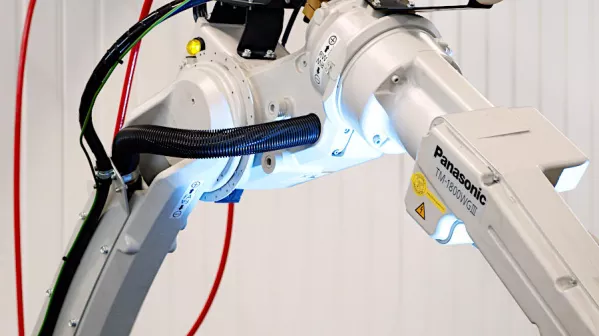
Just a decade or two ago, a robotic welding line was the exclusive domain of the largest automotive corporations. Today it is standard in manufacturing facilities of all sizes — from small metalworking shops to global industrial enterprises. What made this technology so widespread? The answer lies in its architecture: a precisely designed ecosystem of components that together create an efficient, safe, and intelligent production workstation.
The robot arm is the foundation of the entire system. It is responsible for path precision, positioning repeatability, and — to a large extent — production throughput.
Not every welding robot looks the same. The choice of architecture depends on the characteristics of the parts being produced:
Serial (Anthropomorphic) Robots — 6 Axes
By far the most popular choice. They mimic the structure of a human arm: they can reach almost any point in the workspace and position the torch at any angle. They work well in 90% of typical welding applications — from body panels to steel structures.
SCARA Robots
Specialized for welding flat components or working in confined spaces. Their advantage is very high movement speed in the horizontal plane.
Parallel Kinematics Robots
Used where dynamics matter above all else. They require less installation space, but at the cost of reduced reach.
Gantry Systems
When the part is larger than the robot — we reverse the concept. The robot moves above a stationary or slowly rotating structure. Ideal for welding vehicle frames, tanks, or structural assemblies.
Modern welding robots are not just mechanics — they incorporate a range of thoughtful engineering details:
The welding torch is the point where all the system's precision meets the metal. Selecting the right tool has a direct impact on weld quality, service frequency, and total operating costs.
MIG/MAG remains the dominant method in robotic welding due to its high productivity and versatility.
Air-cooled torches (up to 300 A) perform well with thinner materials and shorter cycles. They are lighter and cheaper to maintain, but have limitations under high heat load.
Liquid-cooled torches (up to 600 A) are the choice for intensive high-volume production. The coolant circuit maintains process parameters even during extended welding runs.
Torches with integrated sensors are becoming increasingly popular — built-in arc voltage, temperature, and gas flow sensors enable real-time process monitoring without external sensors.
The TIG method is slower than MIG/MAG, but produces welds of exceptional cleanliness and visual appearance. In robotic welding, it is used primarily in the aerospace, pharmaceutical, and stainless steel equipment manufacturing industries.
Specialized TIG torches for robots are equipped with, among other things, rapid tungsten electrode exchange systems — without the need to stop the line.
Robotic laser welding is gaining ground wherever minimal thermal distortion and highly precise welds on thin materials are required. Hybrid heads (laser + MIG/MAG) combine the penetration depth of laser with the productivity of arc methods.
Irregular wire feeding is one of the main causes of weld quality issues. That is why selecting the right feeder system matters so much:
For high-volume production, drum packages (100–300 kg) are key — they enable hours of uninterrupted operation without spool changes.
Even a mechanically excellent robot is useless without an intelligent control system. It is the controller and software that determine how effectively the system handles complex parts and variable production conditions.
Modern controllers are not merely "control boxes" — they are integrated computing units combining robot motion control with real-time welding process management.
Key capabilities:
The era of analog current regulators is over. Modern inverter-based welding power sources offer digital process parameter control at frequencies of several kHz, delivering previously unattainable arc stability.
Advanced operating modes such as CMT (Cold Metal Transfer), pulsed welding, and AC MIG open new possibilities for joining difficult materials — thin sheet metal, aluminum, and high-alloy steels — without the risk of burn-through or distortion.
Online Programming (Teach-In)
The operator physically guides the robot through trajectory points using a teach pendant. An intuitive and proven method, but time-consuming for complex parts or production changeovers.
Offline Programming (OLP)
Programming takes place virtually, in a CAD/CAM environment, without stopping production. The robot "sees" the part only when the finished program is launched. Modern OLP systems can automatically generate welding paths from a 3D model, accounting for reachability, collisions, and process parameters.
Worth knowing: For low-volume production or frequent product changes, the time savings from OLP can reach as much as 60–70% compared to manual programming.
Hybrid Approach
An increasingly popular solution: a preliminary path generated offline, then refined by the operator at the station. Systems incorporating machine learning elements can over time optimize paths based on accumulated production data.
The robot's precision alone is not enough if the part is poorly fixtured or positioned awkwardly. Auxiliary equipment is an often underappreciated factor in the final quality of the process.
Welding in the flat position (part horizontal, weld on top) is the easiest and yields the best quality results. Positioners enable automatic placement of the part in this optimal position, regardless of its original orientation.
Types of positioners:
Positioner load capacities range from a few dozen kilograms for small parts up to 20 tonnes for large steel structures.
When a single robot must serve several stations, or the welded component exceeds standard reach, travel tracks are the solution. They allow the robot to move along the production line, serving successive parts or collaborating with other robots.
Even the most precise robot cannot compensate for an inaccurately fixtured part. A good welding fixture provides:
Spatter and burned metal accumulating on the torch tip degrades weld quality. Automated cleaning stations, integrated into the robot's work cycle, perform:
Regular automated cleaning can extend torch service life several times over.
Program precision is one thing. Production reality is another — parts have dimensional tolerances, welds have variable geometry, and temperature causes distortion. Adaptive sensors allow the system to respond to these variables in real time.
Arc Sensors
Use the welding arc itself as a sensor. By analyzing voltage changes during torch oscillation, the system detects joint position and continuously corrects the trajectory. A simple, reliable method — no additional mechanical sensors required.
Vision Sensors
2D/3D cameras and laser scanners enable:
Touch Sensors
The robot "searches" for the joint through physical contact — a simple and effective method for locating part position before welding begins.
The best robotic welding systems do not just weld — they simultaneously verify process quality:
A modern robotic welding station is not an isolated production island — it is a fully integrated node in the digital plant network.
Welding stations must meet the requirements of ISO 10218-1/2 and ISO/TS 15066 (for human-robot collaboration applications). Typical safety measures include:
Welding fumes contain metal particles and chemical compounds that pose health hazards. An effective ventilation and filtration system is both a legal requirement and an ethical one:
Integration with higher-level systems is the direction the entire industry is heading:
Each of the described components — robot arm, torch, controller, positioner, sensor, safety system — fulfills a defined role. Yet the true value of robotic welding only becomes apparent when all these elements work in harmony as an integrated system.