poczta@prometalform.eu
+48 95 762 08 61
+48 95 762 08 61
Modern technologies of metal working
Laser beam cutting
Laser cutting of tubes and sections
Robotic welding
Sheet metal bending
+48 95 762 08 61
Laser beam cutting
Laser cutting of tubes and sections
Robotic welding
Sheet metal bending
The modern metalworking industry is constantly raising the bar. Increasingly complex structures, growing demands for manufacturing accuracy, shorter lead times and the need to optimise costs mean that traditional production methods are increasingly being replaced by advanced technologies. In this environment, modern machinery has become one of the most important factors determining a company's competitiveness.
At Pro Metal Form, we understand that even the best design requires the right technological resources to meet customer expectations. That is why we have consistently invested in expanding our machinery for many years, selecting equipment from renowned global manufacturers. Advanced laser systems, robotic welding stations, CNC press brakes and metal forming equipment create a comprehensive manufacturing environment where precision meets efficiency.
However, our greatest strength lies not only in technology itself but also in our ability to integrate different metalworking processes into a single, efficiently functioning production system. This enables us to manufacture both individual, technically demanding components and extensive production series for various industrial sectors.
Modern metal manufacturing requires much more than individual pieces of equipment, however advanced they may be. The key is to combine complementary technologies that enable seamless transitions between successive stages of production.
At Pro Metal Form, we have developed a machinery infrastructure capable of handling a wide range of technological processes. These primarily include laser cutting of sheet metal, tubes and profiles, CNC sheet metal bending, robotic welding, punching and metal stamping. These resources allow us to respond flexibly to customer requirements and select solutions that are optimal from both technical and economic perspectives.
Production preparation also plays an important role. Proper technical documentation, the selection of process parameters, optimisation of material utilisation and careful planning of operations directly affect the quality of the finished product. Modern machinery supports these activities, but the final result also depends on the knowledge and experience of our manufacturing engineers, programmers and machine operators.
One of Pro Metal Form's key areas of expertise is precision sheet metal laser cutting, performed using an advanced Trumpf laser cutting machine equipped with a 6 kW TruDisk laser source.
Laser technology has revolutionised the manufacturing of metal components. It enables the production of complex contours, holes, cut-outs and highly accurate parts, often without the need for additional mechanical tools. Unlike many traditional machining methods, laser cutting does not require direct contact between the tool and the material, reducing the risk of mechanical deformation.
The TruDisk laser source installed in our machine generates radiation with a wavelength of approximately 1.03 µm. This is considerably shorter than that of traditional CO₂ lasers, promoting efficient energy absorption by many metals and enabling high processing efficiency.
Our laser cutting machine can process sheets measuring up to 3000 × 1500 mm, providing extensive manufacturing capabilities for both small components and larger structural elements. Depending on the material, we can cut:
This broad range of capabilities allows us to handle projects involving various materials, from common grades of structural steel to more technologically demanding metals.
The modern Trumpf laser cutting machine offers much more than a powerful laser source. Its capabilities are also determined by advanced solutions that support the cutting process.
BrightLine enables high edge quality, particularly when processing thicker materials. This technology facilitates the production of demanding contours and holes, improving the quality of finished components.
TwinLine enables the simultaneous processing of two appropriately positioned components, reducing production programme execution times in certain applications.
FlyCut uses dynamic laser beam control when producing appropriately arranged cut-outs. Reducing unnecessary cutting head movements improves overall process efficiency.
PierceLine supports material piercing before the actual cutting process begins. Optimising this operation is particularly important when processing thicker sheets and manufacturing components containing numerous holes.
Selecting the appropriate assist gas is another important aspect of laser cutting technology. Cutting with nitrogen produces edges free from the oxide layer formed during oxygen-assisted cutting. In many cases, this facilitates subsequent processing, particularly welding and surface preparation for protective coatings.
The high efficiency of laser cutting results not only from the speed of the machine itself but also from the proper preparation of production programmes. By optimising the arrangement of components on sheet metal, we can reduce manufacturing waste and make more efficient use of purchased materials.
This is particularly important when processing stainless steel, aluminium and non-ferrous metals, whose cost represents a significant proportion of the finished product's value. Combining modern technology, programming expertise and effective production planning allows us to offer customers solutions that are beneficial in terms of both quality and manufacturing economics.
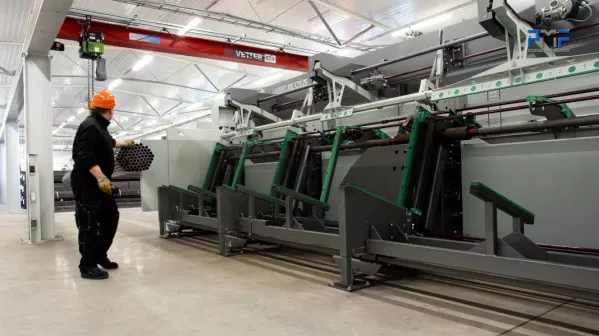
Another important part of our machinery infrastructure is the ADIGE LT 8.20 laser cutting machine, designed for the precision processing of tubes, profiles and special sections.
This advanced machine uses Fiber technology to perform complex three-dimensional cutting operations. Thanks to its tilting laser head, we can perform cuts at angles of up to 45°, significantly expanding our capabilities in preparing components for subsequent assembly and welding.
Traditional tube and profile preparation often requires several separate operations, including cutting to length, drilling holes, milling cut-outs and forming suitable end geometries. Each additional stage requires the component to be repositioned, increases production time and may introduce further inaccuracies.
The ADIGE LT 8.20 laser cutting machine allows many of these operations to be combined into a single technological process. This makes it possible to produce mounting holes, slots, technological cut-outs, interlocking joints and precisely shaped tube ends without transferring components between multiple workstations.
Our machine enables the automatic processing of input materials measuring up to 6500 mm in length, as well as the production of finished components up to 6500 mm long.
The range of supported geometries includes:
These capabilities are particularly useful in the production of frames, support structures, industrial equipment components, and machinery and equipment parts.
The ADIGE LT 8.20 incorporates a range of solutions designed to improve process accuracy and stability.
Active Piercing supports the initial cutting stage by optimising material piercing. Active Focus enables the laser beam's focal position to be adjusted according to processing conditions. Active Weld supports the cutting of tubes and profiles containing a welded seam, while Active Scan enables more accurate detection of the actual geometry of the material being processed.
This is particularly important when working with profiles whose actual dimensions may differ slightly from their nominal values. Accurate scanning and compensation for these differences help maintain the dimensional accuracy of holes and cut-outs.
One of the greatest advantages of laser cutting tubes and profiles is the ability to manufacture components that are almost ready for subsequent assembly. Properly designed cut-outs and end geometries facilitate component positioning, improve joint fit-up and can reduce the need for additional assembly fixtures.
At Pro Metal Form, this is particularly important because laser profile cutting naturally complements our robotic welding capabilities. A precisely prepared component is the foundation of a stable and repeatable welding process.
Welding is one of the most demanding stages in the manufacture of metal structures. Joint quality depends on numerous factors, including edge preparation, component fit-up accuracy, electric arc parameters, welding torch travel speed and the appropriate selection of filler materials.
Repeatability is particularly important in series production. Every successive component should meet the same quality requirements, regardless of the order volume.
That is why one of the pillars of our machinery infrastructure consists of three robotic welding stations equipped with Panasonic TAWERS TM 1800 WG3 robots.
Our welding stations use advanced industrial robots that enable precise torch movement along programmed trajectories. Six-metre travel tracks extend the available working area, allowing welding operations to be performed on large components.
Our welding station configuration also incorporates two independent Panadice 500 positioners, enabling operation within two working areas, each measuring 1200 × 3000 mm. This solution allows us to organise production efficiently, including preparing subsequent components while the robot operates in the other zone, provided that the station configuration and safety systems permit such operation.
Thanks to the appropriate arrangement of equipment and the ability to programme welding trajectories, we can manufacture both smaller components and more complex structures requiring numerous precision joints.
The greatest advantage of robotic welding is its ability to maintain repeatable process parameters. The robot guides the welding torch according to a predefined programme, maintaining the specified speed, position and movement trajectory. The integrated TAWERS control system enables precise management of welding parameters, contributing to arc stability and joint quality.
In practice, this means reduced variability associated with manual torch movement, greater process predictability and efficient execution of repeatable production series.
Robotic automation also plays an important role in safety. Properly protected welding stations reduce operators' direct exposure to welding arc radiation, spatter and other hazards associated with the welding process.
Our technological infrastructure enables us to use welding processes tailored to the material type and structural requirements.
MAG welding is one of the most commonly used methods for joining steel components. It uses a consumable electrode shielded by an active gas or an appropriate gas mixture. This technology provides high productivity and is particularly suitable for manufacturing steel structures and components.
TIG welding uses a non-consumable tungsten electrode and an inert shielding gas. It enables highly precise process control and is therefore used, among other applications, for demanding stainless steel and aluminium joints.
The choice of welding method depends on numerous factors, including material grade, component thickness, joint type, strength requirements and the expected weld surface quality.
Although robotics is primarily associated with work automation, it actually requires extensive technological knowledge. Preparing suitable welding programmes, selecting process parameters, designing fixtures and performing quality control remain tasks that require experienced specialists.
At Pro Metal Form, we regard welding robots as tools that enable our manufacturing engineers and operators to perform even highly demanding processes with greater accuracy and predictability.
Manufacturing many metal components requires flat sheets to be formed into specific three-dimensional geometries. Machine housings, brackets, protective covers, structural elements and industrial equipment components are often produced through precision sheet metal bending.
At Pro Metal Form, we use two modern DENER press brakes: the PUMA XL 220-30 and the SERVOBRAKE 4015. These machines differ in their design and operating characteristics, allowing their capabilities to complement one another.
The DENER PUMA XL 220-30 press brake has been designed for demanding bending operations. It enables the processing of sheet metal up to 30 mm thick, with a maximum bending length of 2200 mm, depending on the material type, component geometry and tooling used.
The machine is equipped with an advanced CNC control system capable of controlling up to twelve axes. Precise positioning of working elements and a crowning system that compensates for table deflection help achieve the required bending angles along the entire length of the component.
This is particularly important when manufacturing structural components, where even minor dimensional deviations can complicate subsequent assembly or welding.
By properly preparing bending programmes, we can manufacture both simple shapes and more complex components requiring several successive operations.
The second press brake in our machinery infrastructure is the DENER SERVOBRAKE 4015, which incorporates a modern servo-electric drive system.
The machine provides a pressing force of 40 tonnes and enables bending operations along lengths of up to 1530 mm. Unlike conventional hydraulic press brakes, it uses an electric drive controlled by servomotors, offering numerous technological and operational benefits.
Above all, this solution enables highly accurate control of the machine's working elements. The high dynamic performance of the drive helps shorten cycle times, while precise control facilitates repeatable bending operations.
An additional advantage is reduced energy consumption, particularly during idle periods between successive operations. The absence of a conventional hydraulic system also reduces maintenance requirements associated with hydraulic oil, filters and seals. Quieter drive operation improves operator comfort and working conditions throughout the production facility.
Having two press brakes with different operating characteristics allows us to allocate manufacturing tasks efficiently. Depending on material thickness, bending length, component geometry and production volume, we can select the machine best suited to each individual project.
We process materials including S235 and S355 structural steels, stainless steel, aluminium and selected metal alloys. The appropriate selection of tooling, pressing force and bending parameters enables high dimensional accuracy while reducing the risk of material damage.
One of Pro Metal Form's greatest advantages is the ability to carry out multiple successive production stages within a single company.
Imagine a steel structural component that requires precision contour cutting, mounting holes, several bending operations and joining with other components through welding.
In a traditional manufacturing model, individual stages might be performed by several independent subcontractors. This would involve organising transportation, additional dimensional inspections, coordinating deadlines and transferring technical documentation between companies.
Thanks to our technological infrastructure, many of these operations can be performed within a single facility. A component cut using the Trumpf laser can then be transferred to a DENER press brake and, following appropriate preparation, joined with other components at a Panasonic robotic welding station.
In the case of tubular structures, the ADIGE laser cutting machine plays a similar role, preparing profiles for subsequent welding and assembly.
This production model delivers tangible benefits to customers: easier order coordination, fewer transportation operations, more efficient information flow and greater control over compliance with technical documentation throughout successive production stages.
In many industrial sectors, even minor dimensional deviations can affect the proper functioning of a finished product. This is particularly important for machine components, precision structures and parts intended for medical and rehabilitation equipment.
Pro Metal Form has experience in manufacturing components for precisely these types of applications, where not only the mechanical properties of materials but also manufacturing accuracy, aesthetics and repeatability are essential.
Modern machinery helps us maintain stable manufacturing processes. CNC control enables programmed operations to be reproduced repeatedly, laser systems ensure precise tool guidance, and welding robots help reduce variability in process parameters.
However, automation alone does not guarantee quality. Proper technical documentation, material selection, dimensional inspection and effective work organisation remain equally important. That is why we combine technological development with the continuous improvement of our employees' skills.
Modern machinery is often associated primarily with high productivity. In practice, its impact on manufacturing economics is much broader.
Appropriately selected technologies help reduce the number of operations, shorten component preparation times, minimise material consumption and reduce the need for additional processing. In series production, even small time savings per component can significantly improve the efficiency of an entire order.
Laser cutting of tubes and profiles is a good example. Producing several holes and cut-outs in a single operation can eliminate the need for subsequent drilling or milling. Similarly, precision CNC bending reduces the number of trial setups, while robotic welding enables more efficient execution of repeatable production series.
At Pro Metal Form, we analyse projects not only in terms of manufacturing feasibility but also in terms of how the entire process can be organised. This allows us to propose solutions that combine the required quality with reasonable manufacturing costs.
Even the most advanced equipment cannot reach its full potential without a properly trained team. Modern metalworking requires expertise in materials science, CNC programming, welding technology, industrial automation and production process planning.
That is why Pro Metal Form places great emphasis on developing the skills of its employees. Participation in training programmes, industry trade fairs and technology events allows us to discover new solutions, exchange experience and improve our manufacturing methods.
It is this combination of modern machinery and specialist expertise that enables us to undertake increasingly demanding projects. We approach every project individually, regardless of whether it involves a single prototype or a larger production series.
Our extensive technological infrastructure enables us to cooperate with companies representing various industrial sectors. Our capabilities include the manufacture of metal components used in machinery structures, industrial equipment, and rehabilitation and medical equipment.
Cooperation with international customers, particularly those in the German market, is also an important area of our business. Participation in international industry trade fairs allows us to showcase our manufacturing capabilities, establish business relationships and gain insight into the expectations of customers operating in competitive European markets.
International cooperation requires not only appropriate technical capabilities but also punctuality, effective communication and consistent adherence to agreed quality standards. That is why we regard the development of our machinery infrastructure as part of a long-term strategy for building lasting relationships with business partners.
The metalworking industry is constantly evolving. Automation, digital production preparation, process integration and technologies that reduce energy and material consumption are playing an increasingly important role.
At Pro Metal Form, we closely monitor these developments and systematically expand our technological capabilities. We regard investment in modern machinery not as an end in itself but as a means of improving manufacturing quality, efficiency and flexibility.
Of particular importance to us is the ability to undertake increasingly complex projects without involving multiple independent contractors. Expanding our technological infrastructure allows us to broaden our range of services and respond more effectively to the needs of companies seeking a comprehensive metalworking partner.
Solutions that support efficient resource management are equally important. Optimising sheet metal nesting, reducing the number of manufacturing operations, using energy-efficient drives and precisely controlling processes help minimise material losses and manufacturing costs.
Pro Metal Form's modern machinery infrastructure is the result of many years of investment and a consistently implemented development strategy. It includes advanced equipment from leading global manufacturers, such as the Trumpf TruDisk 6 kW laser, the ADIGE LT 8.20 tube and profile laser cutting machine, three Panasonic TAWERS TM 1800 WG3 robotic welding stations, and the DENER PUMA XL 220-30 and SERVOBRAKE 4015 press brakes.
These resources are complemented by eccentric and hydraulic presses, as well as technologies enabling subsequent stages of metal component manufacturing and assembly.
By combining these capabilities, we can offer comprehensive metalworking services – from the preparation of individual components to the manufacture of more complex structures and extensive production series.
Our goal is to deliver solutions that meet the actual needs of our customers: precise, functional, repeatable and economically justified. We believe that the best results are achieved where advanced technology meets experience, responsibility and a professional approach to every project.
We invite you to cooperate with Pro Metal Form. If you are looking for a partner with modern machinery, extensive metalworking capabilities and experience in delivering demanding projects, we are ready to work with you to develop the optimal technological solution.