poczta@prometalform.eu
+48 95 762 08 61
+48 95 762 08 61
Modern technologies of metal working
Laser beam cutting
Laser cutting of tubes and sections
Robotic welding
Sheet metal bending
+48 95 762 08 61
Laser beam cutting
Laser cutting of tubes and sections
Robotic welding
Sheet metal bending
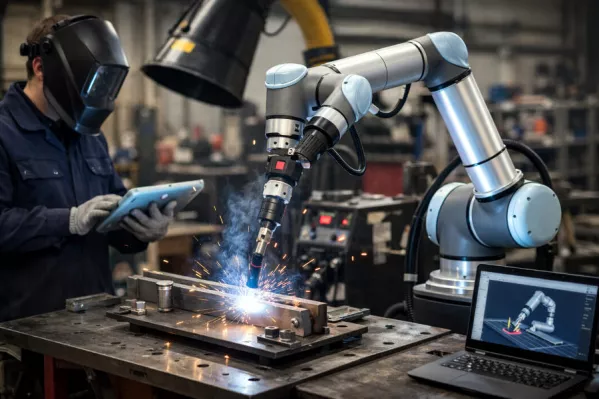
Traditional industrial robots dominated automated welding processes for decades – powerful, fast, and locked behind safety barriers and cages. Today, a smaller, more flexible cousin is increasingly appearing on production floors: the cobot (collaborative robot). Its presence is changing not only how work is organized, but the very philosophy of automation in welding.
A cobot is a robot designed for direct collaboration with humans in the same workspace. Unlike classic industrial robots:
This is the most popular application for welding cobots. A cobot fitted with a MIG/MAG torch excels at:
TIG cobots are used where exceptional weld quality is required – in aerospace, medical, and food industries. Precise motion and arc parameter control allows achieving welds to EN ISO 5817 Level B standard.
Modern cobots are increasingly integrated with laser heads, opening up possibilities for welding thin steel sheets and aluminum without the risk of thermal distortion.
CMT technology, used by Fronius among others, works ideally with cobots for joining dissimilar materials (e.g. steel with aluminum alloys).
The ISO/TS 15066 standard defines contact force and pressure limits that a cobot operating in collaborative mode must meet. Built-in torque sensors in every axis enable:
In the era of mass customization, the ability to quickly reprogram a cobot is invaluable. A production changeover that takes several hours with a classic robot can take just 15–30 minutes with a cobot.
The average cost of deploying a cobot welding station is 30–60% less than an equivalent industrial robot station, primarily due to:
The shortage of qualified welders is a global problem. Cobots do not replace them entirely – rather, they allow experienced operators to focus on tasks requiring judgment and expert knowledge (setup, quality control, prototype welding), while the cobot handles tedious, repetitive welds.
Despite their many advantages, cobots in welding are not without limitations. A significant issue is welding speed – cobots are slower than traditional robots, which can limit throughput in high-volume production. Equally important is payload and reach: the limited arm reach (typically 850–1300 mm) requires careful workstation planning.
Safety in the welding arc zone must also not be overlooked. UV radiation, spatter, and welding fumes require additional protection even when a cobot is working nearby instead of a classic robot. A separate challenge is Tool Center Point (TCP) calibration – precise TCP setup is critical for weld quality and demands operator experience. Finally, for long welds, thermal distortion compensation is necessary: material stresses and deformations require advanced path correction algorithms.
Welding cobots are increasingly integrated with:
The global industrial cobot market was valued at approximately $1.5 billion in 2023 and, according to industry analyses, is expected to grow at a CAGR exceeding 30% through 2030. The welding segment is one of the fastest-growing application areas, driven by:
Cobots are not the answer to every challenge in robotic welding – they will not replace classic robots in large-scale mass production. However, they are the ideal tool for small and medium-sized enterprises, low-volume production, and environments where flexibility and safety outweigh maximum throughput.
The core value of cobots lies in their capacity to democratize automation – enabling companies that previously could not afford robotization to reach a new level of welding repeatability and quality. Combined with the growing intelligence of control systems and AI integration, welding cobots are becoming one of the cornerstones of Industry 4.0 in metallurgy and structural steel production.