poczta@prometalform.eu
+48 95 762 08 61
+48 95 762 08 61
Modern technologies of metal working
Laser beam cutting
Laser cutting of tubes and sections
Robotic welding
Sheet metal bending
+48 95 762 08 61
Laser beam cutting
Laser cutting of tubes and sections
Robotic welding
Sheet metal bending
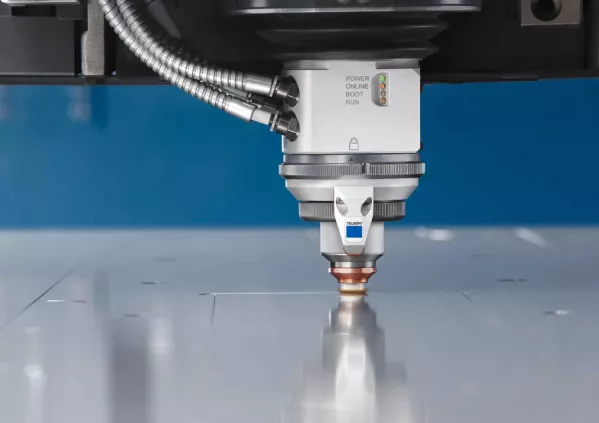
Imagine a structural component in an aircraft that doesn't fit its socket by just 0.3 mm. Or a medical device enclosure where the gap between panels is barely visible to the naked eye, yet disqualifies the entire project. In the world of metalworking, precision isn't a matter of aesthetics — it's a matter of safety, functionality, and reputation.
Laser cutting of sheet metal has long been the gold standard of dimensional accuracy. But what really lies behind the phrase "high precision"? And what makes one part come out perfectly, while another — despite using the same machine — doesn't quite measure up?
Precision isn't just about "how accurately we cut." It's the machine's ability to consistently reproduce the same dimension — time and again, on every part in a series, whether it's the first piece or the five hundredth.
Precision is measured in dimensional tolerances — the permissible deviations from the nominal values specified in the design. The tighter the tolerance, the higher the demands on the process and equipment.
Modern fiber lasers used at Pro Metal Form achieve tolerances of:
For reference — a human hair is approximately 0.07 mm thick. We're talking about accuracy that the human eye simply cannot assess without measuring instruments.
Precision doesn't come from nowhere. It's the result of many factors that must work in perfect synchrony.
Fiber lasers have replaced older CO₂ technology in many applications, and for good reason. Their shorter wavelength and higher energy density produce narrower cutting gaps and cleaner edges — especially on thin sheets of stainless steel, aluminum, or copper.
CO₂ lasers still excel with thicker non-metallic materials, but when it comes to sheet metal and strict tolerances — fiber wins decisively.
This is one of the most important variables. The thinner the sheet, the more precise the cut — the laser beam has less material to process and a smaller heat-affected zone.
Material grade also matters enormously:
Too fast = irregular edges, risk of incomplete cuts, degraded surface quality. Too slow = wider kerf, larger heat-affected zone, thermal distortion.
The optimal speed is the result of operator expertise and precise control software — and this is where a production facility's know-how truly makes the difference.
Even the best laser is only as good as its optical system. The focusing lenses must be cleaned and calibrated regularly. Even minor contamination of the optics can widen the cutting gap and introduce uncontrolled dimensional deviations.
A single good result isn't enough. In series production, what counts is repeatability — and that's where process control systems come in.
Modern laser machines are equipped with:
At Pro Metal Form, regular machine calibration and systematic analysis of measurement data are standard practice. This allows us not only to maintain, but to continuously improve the tolerances we achieve.
The metalworking industry operates with concrete standards. Two key reference points for laser cutting are:
Depending on client requirements and the specific application, we select the appropriate quality class and confirm its achievement with measurement documentation.
High-tolerance laser cutting technology isn't a "luxury" reserved for select industries. Today, it's a standard across many sectors:
The automotive industry produces body components, brackets, and guides where safe assembly, aesthetics, and series repeatability are paramount — a deviation on one part means a problem across the entire production line.
The electronics sector requires enclosures, rack cabinets, and panels with openings precisely matched to connectors and modules. Even a minor inaccuracy prevents proper component assembly.
The medical sector has the most rigorous requirements of all — diagnostic equipment, surgical instruments, and implants must meet strict safety standards where the margin for error is effectively zero.
The aerospace industry combines two seemingly contradictory demands: minimum weight with maximum strength. Airframe and engine structural components must pass certification, and tolerances here are critical — in every sense of the word.
Architecture and design — facades, railings, and decorative elements must form a cohesive whole across large surfaces. Here, precision is an aesthetic matter: uneven gaps or mismatched modules are immediately visible to every passerby.
When choosing a laser cutting service provider, it's worth asking: what does inaccuracy actually cost my business? Corrections, rejects, delays, complaints — each costs many times more than placing a single order with a trusted partner.
At Pro Metal Form, dimensional precision isn't a marketing slogan — it's a measurable result, confirmed by documentation and backed by years of sheet metal processing experience. We offer tolerances down to ±0.05 mm, work with modern fiber lasers, and tailor process parameters individually to every project.
Have a project that demands high precision? Contact us — we'll be happy to find the optimal solution.