poczta@prometalform.eu
+48 95 762 08 61
+48 95 762 08 61
Modern technologies of metal working
Laser beam cutting
Laser cutting of tubes and sections
Robotic welding
Sheet metal bending
+48 95 762 08 61
Laser beam cutting
Laser cutting of tubes and sections
Robotic welding
Sheet metal bending
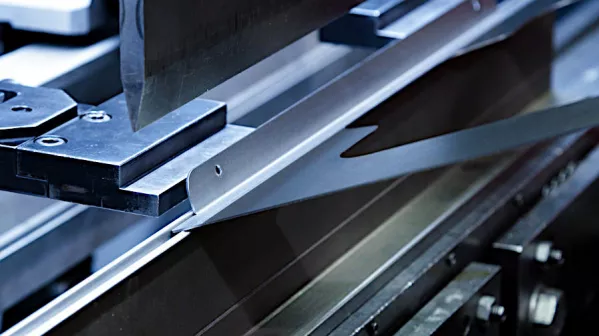
Modern metalworking industry places increasingly high demands on the accuracy of manufactured components. Sheet metal bending is one of the key production processes, and computer numerically controlled (CNC) press brakes have revolutionized the way manufacturing plants approach this task. The combination of advanced software, precision actuators, and multi-axis control systems makes it possible to achieve tolerances that were impossible to attain in a serial production environment just a decade ago.
A CNC press brake is a press brake equipped with a numerical control system that manages all the critical parameters of the bending process. The CNC controller governs primarily the punch penetration depth (the Y-axis stroke), the position of the back gauge (X and R axes), the bending angle, and the clamping force of the beam. Modern machines typically feature between six and several dozen controlled axes, enabling complex bending sequences to be carried out without the need for manual retooling.
The operator programs the machine using dedicated CAM software or directly via the control panel, entering the part geometry, material type, and thickness. The system automatically calculates springback compensation, selects the optimal bending force, and generates a sequence of movements for each operation.
Material springback after the punch pressure is released is one of the greatest challenges in sheet metal bending. Every metal, after plastic deformation, "returns" by a certain angle, depending on its mechanical properties, thickness, and bending radius. Modern CNC systems address this phenomenon in several ways.
The first approach is angular overbending — the machine bends the sheet a few degrees beyond the desired final angle, anticipating the amount of springback based on a material database. A more advanced method is adaptive bending, in which a measurement system (such as a laser or angular encoders) measures the angle immediately after each stroke and corrects the parameters of the next bend in real time. As a result, even when material properties vary from batch to batch, repeatability at the level of tenths of a degree is achieved.
The back gauge determines the position of the sheet relative to the bending axis. In CNC press brakes, it is controlled to an accuracy of 0.01 mm, which directly translates into repeatable flange lengths of the bent part. In multi-axis machines, the gauge can move in three dimensions, allowing proper support of complex shapes without colliding with previously formed bends.
Choosing the right punch-and-die combination is of great importance to bending quality. The punch radius should be matched to the material thickness, and the die opening width should suit the required angle and bending force. CNC press brakes allow for rapid exchange of segmented tooling, which shortens changeover time and minimizes the risk of incorrect installation. However, careful leveling and securing of the tooling is essential, since even a minor geometric deviation in the tools is transferred directly to the accuracy of the finished part.
Integration of measurement systems into the bending process is standard practice in advanced production environments. Laser cameras mounted directly on the machine beam can measure the bend angle after each stroke, with data transmitted immediately to the CNC controller for correction. Such systems eliminate the need for manual first-article inspection and allow tolerances of ±0.1° to be maintained throughout an entire production run.
Before the sheet reaches the machine, CAM software allows the entire bending process to be simulated in a virtual environment. 3D simulation reveals any potential collisions between the part and the beam or tooling, enables optimization of the bending sequence, and verifies whether the desired geometry is achievable at all for a given machine. Offline programming reduces machine setup time by as much as 70% compared to traditional methods and eliminates costly errors at the production stage.
The greatest advantage of CNC technology in sheet metal bending is repeatability. Once a part is programmed, it can be produced with identical dimensions for years, regardless of changes in operator. Control systems record all process parameters, which facilitates quality tracking and compliance with quality management systems such as ISO 9001.
Another key benefit is flexibility. Switching between different parts amounts to loading a new program and, if necessary, changing the tooling — an operation that in modern machines takes just a few to several minutes. This enables economical production of small batches and even one-offs, without any loss of precision.
CNC press brakes also offer significantly greater workplace safety than conventional machines. Laser light curtains, beam speed monitoring systems, and automated sequences prevent accidental machine activation in hazardous zones.
It is also worth highlighting waste reduction. Precise springback compensation and in-process angle verification minimize the number of rejects and rework operations, which directly lowers material costs.
Despite their many advantages, achieving high precision with CNC press brakes involves a range of challenges.
Even sheets from the same delivery can exhibit differences in yield strength and Young's modulus depending on the rolling direction or temperature during production. These deviations affect the degree of springback and can disrupt process repeatability, even when the machine is perfectly calibrated.
A CNC press brake is a complex electromechanical device that requires regular calibration and maintenance. Wear of ball screws, bearings, and guideways, as well as encoder drift, can gradually degrade machine accuracy. Periodic inspections are required, and every service intervention must be confirmed by measurement procedures.
Modern CNC press brakes with advanced in-process measurement systems represent a significant investment. In addition to the cost of the machine itself, CAM software, personnel training, and the construction of IT infrastructure to enable offline programming and management of manufacturing documentation must all be factored in.
Not all shapes can be formed on a CNC press brake in a single operation. Parts with deep box shapes, small bending radii, or those requiring very high forces relative to a narrow beam may need custom tooling, additional operations, or specialist machinery. Properly planning the bending sequence is an art in itself and demands considerable technical experience.
Although CNC press brakes automate many tasks, they still require skilled personnel. A programmer must understand the physical phenomena involved in bending, material properties, and the machine's limitations. Errors at the programming stage can lead to damage to the tooling, the machine, or the production of defective batches.
To fully leverage the capabilities of CNC press brakes, manufacturers should implement several proven strategies.
First and foremost, investing in a material database is essential. Accurate data on the mechanical properties of the materials used — gathered empirically or obtained from the supplier — forms the foundation of effective springback compensation. Regularly updating this database based on production measurement results allows the CNC system to predict material behavior with increasing accuracy.
Equally important is the implementation of statistical process control (SPC). Systematic measurement of angles and dimensions of bent parts, followed by analysis of results over time, makes it possible to detect trends and make corrections before tolerances are exceeded. SPC enables a shift from reactive to proactive quality management.
Maintaining production hall temperature is also critical. Both the machine and the material respond to temperature changes. Significant daily fluctuations can cause thermal expansion of machine components and alter sheet properties, resulting in dimensional errors. In high-precision manufacturing, stabilizing ambient temperature is standard practice.
Finally, regular machine calibration in accordance with the manufacturer's schedule, combined with documented results, ensures that machine accuracy is maintained throughout its service life and allows gradual component wear to be detected before it affects production quality.
Precise sheet metal bending with CNC press brakes is a field that combines advanced mechanics, electronics, and materials engineering. The technology offers exceptional repeatability, flexibility, and the ability to achieve tolerances unattainable with conventional machines. At the same time, it requires appropriate infrastructure, competent personnel, and a systematic approach to process management. Companies that successfully implement these solutions gain a significant competitive advantage — the ability to deliver precision components in short runs, with high repeatability and low scrap rates. In the face of growing customer demands and increasingly stringent tolerances in industries such as aerospace, automotive, and electronics, investing in modern CNC press brakes is becoming not an option, but a necessity.