poczta@prometalform.eu
+48 95 762 08 61
+48 95 762 08 61
Modern technologies of metal working
Laser beam cutting
Laser cutting of tubes and sections
Robotic welding
Sheet metal bending
+48 95 762 08 61
Laser beam cutting
Laser cutting of tubes and sections
Robotic welding
Sheet metal bending
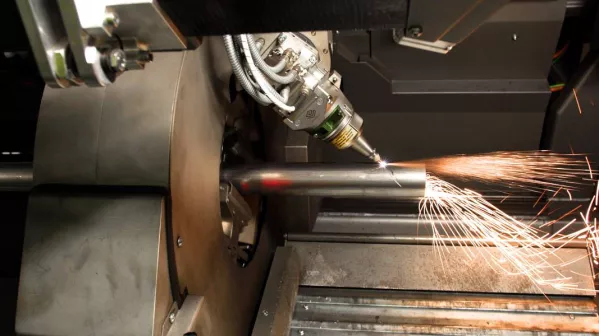
Imagine a machine that, in one fluid motion, cuts a precise hole at a 45-degree angle in a steel pipe, bevels the edge for welding, and makes a decorative notch — all without changing tools, without downtime, without compromising quality. This isn't a vision of the future. It's everyday reality in facilities that use 3D laser cutting.
At Pro Metal Form, we work with this technology daily. In this article, we explain exactly how it works, how it differs from 2D cutting, and why it's changing the rules of the game in metal processing.
Classic 2D laser cutting works on flat sheet metal — the cutting head moves along the X and Y axes, cutting contours from a sheet of material. Simple, fast, effective — but limited to a single plane.
3D laser cutting goes a step (or rather, several axes) further. The laser head can move through space, tilt at any angle, and work around a rotating workpiece. Instead of flat sheet metal — pipes, closed profiles, channel sections, I-beams, special structural shapes.
A highly focused, high-energy beam of light strikes a precisely defined point on the metal surface. In a fraction of a second, the material at that point melts, burns, or vaporizes — creating a clean cutting gap. A process gas (oxygen, nitrogen, or argon) blows the molten material out of the gap and cools the cutting zone.
The entire process is controlled by an advanced CNC system that synchronizes:
Modern systems operate on five or more axes simultaneously — hence the ability to process even highly complex geometries.
3D laser cutting machines differ in how they achieve freedom of movement. There are two main approaches:
The workpiece rotates around its own axis while the laser head moves along linear axes. This solution works excellently for pipes and profiles with a regular cross-section — it delivers high speed and repeatability.
Here, the workpiece is held and positioned by an arm with at least five degrees of freedom. The system is slower but offers exceptional precision — particularly with heavy or irregularly shaped sections.
The choice of system depends on the type of parts being produced, their dimensions, and quality requirements.
Not every laser works the same way. In 3D metal cutting, three main technologies are used, each with different strengths.
The oldest of the three, but still highly effective. It generates a beam with a wavelength of 10.6 μm — well absorbed by carbon and low-alloy steel. It delivers exceptional edge quality, especially when cutting thicker materials.
Worth knowing: The CO₂ laser struggles with aluminum and copper — these metals strongly reflect its beam. It also requires an elaborate optical system with moving mirrors.
Currently the most popular choice in new installations. The beam at 1.07 μm is better absorbed by metals — including reflective ones. The fiber laser delivers its beam via a flexible optical fiber directly to the cutting head, simplifying machine construction and reducing maintenance.
Energy efficiency of 25–35% (compared to 8–10% for CO₂) is an argument that often determines the choice of this technology.
The highest beam quality at high power levels — that's its main advantage. The Yb:YAG crystal disk allows for very precise energy concentration, which translates into excellent results when processing thicker walls. However, higher purchase and maintenance costs make it a choice for demanding specialized applications.
This is the question designers and process engineers ask themselves when they first encounter the capabilities of 3D laser cutting. Here are a few application examples that particularly well illustrate the potential of this technology:
Weld joint preparation — precise beveling of pipe edges for welding, angled cuts at various angles, without the need for secondary mechanical processing.
Jigsaw-type joints — cutouts in pipes and profiles that interlock and form rigid structural connections — popular in architectural metalwork and industrial furniture.
Technical and mounting holes — round, rectangular, and irregularly shaped holes, made at an angle to the profile surface — without drilling, without milling.
Decorative elements — perforations, patterns, open-work structures in profiles used in architecture and design.
Processing of variable cross-section components — special structural sections that change geometry along their length are no longer a challenge for 3D systems.
3D laser cutting isn't just about power and speed. The quality of the finished component is influenced by dozens of process parameters that must be matched to the specific material and geometry:
Modern control systems select and adjust these parameters in real time, responding to changes in the geometry of the workpiece and the properties of the material being cut.
No technology is without limitations. In 3D laser cutting, there are a few challenges:
Reflective materials — aluminum and copper reflect the laser beam, requiring the right type of laser (fiber or disk) and careful parameter selection.
Risk of piercing the opposite wall — particularly with pipes of small diameter and thin walls. The solution is precise parameter settings and the use of absorbing inserts inside the pipe.
Thermal deformation — intense heating can lead to workpiece distortion. Heat management and the correct sequence of operations are key to maintaining dimensional tolerances.
Programming complexity — advanced shapes require multi-axis tool paths whose generation demands professional CAD/CAM software and technological expertise.
3D laser cutting technology isn't standing still. The directions in which it is developing:
3D laser cutting is a technology that answers the question: how do you produce complex components from pipes and profiles faster, more precisely, and without multiplying processing operations?
The combination of multi-axis kinematics, precise CNC control, and modern laser sources creates a tool that transforms the way metal structures are designed and manufactured. At Pro Metal Form, we invest in this technology because we know that production quality and flexibility are no longer a competitive advantage today — they are the standard our clients expect.
Do you have a project requiring custom pipe or profile processing? Contact us — we'll help you find the optimal solution.