poczta@prometalform.eu
+48 95 762 08 61
+48 95 762 08 61
Modern technologies of metal working
Laser beam cutting
Laser cutting of tubes and sections
Robotic welding
Sheet metal bending
+48 95 762 08 61

Laser beam cutting
Laser cutting of tubes and sections
Robotic welding
Sheet metal bending
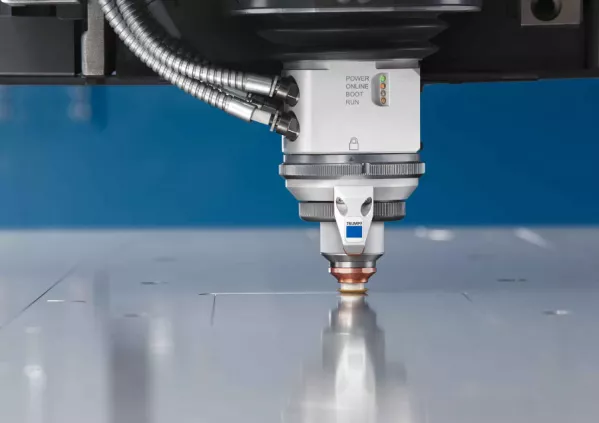
Laser cutting has long been regarded as one of the most precise sheet metal machining methods, capable of producing smooth edges, a narrow kerf width, and a minimal heat-affected zone. Whether a given sheet is cut cleanly and defect-free, or ends up with burrs, scorch marks, or an uneven surface, depends not only on the quality of the laser itself, but above all on the precise selection of process parameters. Beam power, cutting head feed speed, nozzle-to-material distance, and the type and pressure of the assist gas are variables that must be closely coordinated with one another. It is worth examining how each of these factors affects the final cutting result, and why process optimization requires a holistic approach rather than adjusting individual parameters in isolation.
Laser beam power is the parameter every process setup begins with. It determines the amount of energy delivered to the material per unit of time, and therefore whether a given sheet will be melted or vaporized sufficiently to allow a clean cut.
Choosing the right power level is not universal, however — it depends largely on the type of material being processed. Structural steel, stainless steel, and aluminum differ in thermal conductivity, melting point, and the degree to which they reflect laser radiation, all of which directly affect the power required.
Power that is too low relative to the material's thickness and type results in incomplete penetration — the laser fails to cut all the way through the sheet, leaving characteristic material "bridges" on the underside of the cut. Excessive power, on the other hand, while intuitively associated with better performance, in practice widens the kerf, increases edge roughness, and enlarges the heat-affected zone, which can negatively impact the mechanical properties of the material near the cut. The key, then, is to match power to the thickness and physical properties of the specific material, rather than maximizing this parameter in isolation from the others.
Cutting head feed speed is the second pillar of the process, closely tied to laser power and sheet thickness. The thicker the material, the more time is needed to fully melt it and expel it from the kerf, which in practice means the cutting speed must be reduced.
This relationship is not linear, however, and cannot be reduced to a simple formula — the optimal speed is also influenced by laser power, the type of assist gas, and the specific characteristics of the material. In practice, machine manufacturers and CAM software providers supply technology tables that serve as a starting point, though actual parameters often require fine-tuning on the specific machine and batch of material.
Feed speed that is too high relative to sheet thickness results in incomplete cutting — similar to insufficient laser power, unpierced fragments or heavy burrs appear on the bottom edge. This happens because the laser simply doesn't have enough time to melt through the full cross-section of the material before the head moves on.
Conversely, feed speed that is too low leads to excessive heat input into the material. The result is a widened kerf, increased surface roughness, and in extreme cases, scorching and visible discoloration of the edge — a particularly troublesome issue with stainless steel, where surface aesthetics often carry functional significance (for example, in food-industry or medical applications). Excessive heating can also cause local structural changes that affect the mechanical properties of the part in the cutting zone.
Feed speed should therefore not be treated as an isolated setting, but rather as a variable fine-tuned in parallel with laser power, so that the amount of energy delivered per unit length of cut is optimal for the given material type and thickness.
The distance between the cutting nozzle and the sheet surface, though typically expressed in fractions of a millimeter, has a disproportionately large effect on cutting quality. This parameter determines how effectively the assist gas stream reaches the cutting zone and how stable the laser beam is at the point of contact with the material.
Too great a nozzle distance causes the gas stream to disperse before it reaches the kerf. Instead of a concentrated, dynamic jet expelling molten material, the gas loses kinetic energy, resulting in poorer removal of slag from the kerf, increased edge roughness, and a higher risk of burr formation on the bottom edge. Additionally, excessive distance can affect the focusing of the laser beam, reducing power density at the cutting point.
Too small a distance carries different risks — the likelihood of nozzle collision with a warped or uneven sheet surface increases, which can damage the nozzle or interrupt the process. Furthermore, at very short distances, gas flow disturbances can occur due to reflections off the material surface, which paradoxically also worsens the removal of molten metal from the kerf.
Modern laser cutting machines are equipped with automatic nozzle height control systems (so-called capacitive height control), which continuously monitor the distance to the material and adjust the head's position in real time, compensating for sheet unevenness or thermal deformation. Despite this automation, correctly setting the initial baseline distance — matched to material thickness and nozzle type — remains a key starting point for the entire technological process.
The assist gas, introduced coaxially with the laser beam through the cutting nozzle, serves two essential functions: it expels molten or vaporized material from the kerf, and — depending on the gas type — it may also participate in a chemical reaction that supports the process. Choosing the right gas and its pressure is closely tied to the type of material being cut and the desired edge quality.
Oxygen is most commonly used for cutting carbon steel. Its presence triggers an exothermic oxidation reaction of iron, which supplies additional energy to the process, enabling cutting at lower laser power and higher speeds, especially with thicker sheets. The drawback of this method is the formation of an oxide layer on the cut edge, which often requires additional finishing if the part is to be painted or welded, for instance.
Nitrogen, typically applied at significantly higher pressure than oxygen, serves a purely mechanical function — it does not participate in any chemical reaction, but simply blows molten material out of the kerf while protecting the cut edge from oxidation. This allows nitrogen cutting to produce a clean, bright edge free of discoloration, which is particularly valuable when cutting stainless steel and aluminum, where aesthetics and the elimination of further surface treatment are significant advantages. The price for this quality is higher gas consumption and higher operating costs for the process.
Compressed air is sometimes used as a cheaper alternative, mainly for thinner sheets and less demanding applications, where process cost matters more than achieving the highest possible edge quality.
Gas pressure must be precisely matched to material thickness and gas type. Pressure that is too low results in insufficient removal of molten material from the kerf, leading to burrs and an uneven edge. Pressure that is too high, particularly with thinner sheets, can cause turbulence in the gas stream, destabilize the process, and even mechanically deform thin material in the cutting area.
Looking at each parameter in isolation, it's easy to get the impression that each can be optimized independently. In practice, however, laser power, feed speed, nozzle distance, and assist gas pressure and type form a tightly interconnected system — changing one parameter almost always requires adjusting the others. Increasing power without correspondingly adjusting feed speed leads to overheating of the material, just as switching the assist gas from oxygen to nitrogen usually requires simultaneously increasing power and modifying cutting speed to compensate for the absence of the supporting exothermic reaction.
Effective optimization of the laser cutting process, therefore, is not about finding one universal set of settings, but about building a technological knowledge base tailored to a specific machine fleet, the type and thickness of materials being processed, and the desired quality of the final part. Experienced operators and process engineers treat cutting parameters as a starting point for further fine-tuning, regularly verifying edge quality and adjusting settings as needed — which, over time, translates into higher process repeatability, reduced material waste, and lower production costs.