poczta@prometalform.eu
+48 95 762 08 61
+48 95 762 08 61
Modern technologies of metal working
Laser beam cutting
Laser cutting of tubes and sections
Robotic welding
Sheet metal bending
+48 95 762 08 61
Laser beam cutting
Laser cutting of tubes and sections
Robotic welding
Sheet metal bending
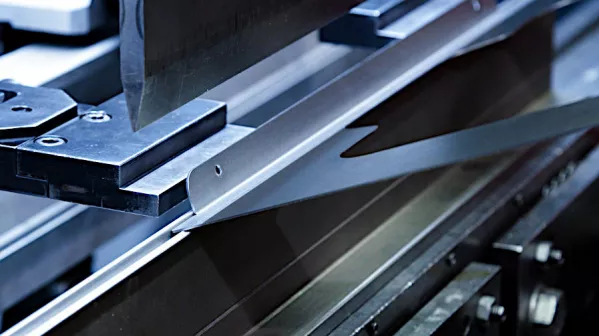
At first glance, sheet metal bending may seem like a simple operation: a flat sheet is placed between a punch and a die, the press moves, and the material takes on the desired shape. In reality, every correctly executed bend involves much more – material properties, properly selected tooling, bending radius, pressing force, part geometry, rolling direction, springback, and the operator’s experience.
This is precisely why press brake sheet metal bending is one of the key stages of modern sheet metal processing. Its accuracy determines not only the appearance of an individual component, but often also whether subsequent operations – welding, assembly, or joining with other components – can be carried out without problems.
Bending is a process of permanently deforming a material. The sheet is placed between the lower tool, known as the die, and the upper tool – the punch. The movement of the punch generates stresses that exceed the material’s yield strength. As a result, once the pressure is released, the sheet does not fully return to its original shape but retains the form it has been given.
It sounds simple, but complex phenomena occur within the bending zone. The outer part of the material is stretched, the inner part is compressed, while between them lies a region whose length changes to a much smaller extent.
This is why producing a component with precise dimensions requires taking into account how a specific material will behave under load.
One of the most important phenomena occurring during forming is material springback. After the punch is withdrawn, the sheet may partially return towards its original shape. As a result, the angle achieved under pressure may differ from the final angle.
The extent of this effect depends, among other things, on:
Structural steel, stainless steel, and aluminium therefore do not behave identically, even when components with exactly the same geometry are being produced.
Modern CNC control systems make it possible to manage this process much more effectively, but technology does not eliminate the need for proper production preparation. The machine must receive the correct parameters for the specific component and material.
The press itself is only one part of the entire process. The tooling used is equally important.
The geometry of the punch affects, among other things, the achievable radius and the way the material deforms. An excessively small radius may increase the risk of damaging the sheet, particularly when working with materials that have lower formability.
The die is just as important. One of its basic parameters is the width of the V-opening. Its selection affects the required pressing force, the internal bending radius, and the behaviour of the material during bending.
There is therefore no single universal press setting suitable for every component. A thin structural steel sheet may require different parameters than stainless steel or a thicker aluminium component.
One of the most commonly used methods is air bending. In this process, the material rests on the edges of the die while the punch presses it at a specific point. The sheet does not have to be pressed all the way to the bottom of the die.
A major advantage of this technology is its flexibility. Precise control of the punch position makes it possible to achieve different angles using the same set of tools. At the same time, the required force can be lower than with methods that require the material to be fully pressed into the die.
An alternative is bottom bending, which makes it possible to reproduce the die geometry more accurately. Coining is another method, requiring significantly greater forces but allowing the springback effect to be reduced.
The choice of method should therefore depend on the requirements of the specific component, the expected accuracy, the material, and the size of the production batch.
Two components with identical dimensions but made from different materials may require completely different process parameters.
Structural steel offers good formability and is widely used in the production of structures, brackets, housings, and machine components.
Stainless steel may require greater forces and proper compensation for springback. Maintaining a high-quality surface finish is also important, particularly for visible components.
Aluminium is lightweight and responds well to many forming operations, but its behaviour depends on the specific alloy and temper. Some alloys are considerably more susceptible to cracking when small bending radii are used.
This is why the information “2 mm sheet metal” is far from sufficient for properly planning the process. The material grade, its mechanical properties, and the geometry of the designed component are equally important.
Many problems encountered at the press originate much earlier – during the component design stage.
The designer should take the technological capabilities of the process into account. Excessively small radii, incorrect distances between holes and bend lines, collisions between successive bends, or geometry that restricts tool access can unnecessarily complicate production.
This becomes particularly important for components requiring several or even a dozen successive bends. In such cases, not only the final shape matters, but also the sequence of operations.
It may turn out that performing one bend too early makes it impossible to position the component correctly for the next operation.
A good design therefore considers not only the question, “What should the finished part look like?” but also: “How can this part be manufactured efficiently?”
This is particularly important for components that have been laser-cut or punched before bending.
If a hole, slot, or other cut-out is located too close to the bend line, material deformation may affect its geometry. A round hole may become distorted, an edge may shift position, and maintaining the required dimensions can become more difficult.
For this reason, designing sheet metal components should combine knowledge of several processes at the same time – cutting, bending, welding, and subsequent assembly.
In series production, producing one correct component is not enough. The same result must be achieved dozens, hundreds, or thousands of times.
Repeatability is influenced by many factors: the properties of successive sheets of material, the condition of the tooling, positioning accuracy, backgauge settings, and the stability of the machine’s operating parameters.
This is where the advantages of modern numerically controlled presses become particularly apparent. CNC technology enables precise control of machine movement, storage of programs for recurring components, and a reduction in the number of manual adjustments.
As a result, returning to the production of a previously manufactured component can be much faster, while process parameters are easier to reproduce.
A finished component is rarely produced solely on a press brake. In practice, bending is often just one stage of a longer technological process.
This process may include:
design → laser cutting → bending → welding → finishing → quality control → assembly
Each stage affects the next. An inaccuracy introduced during bending may later make it more difficult to fit parts together during welding. A design error may require an additional operation. An incorrect bending sequence may unnecessarily increase the time required to manufacture the component.
The greatest opportunities for optimisation therefore arise when a component is viewed not as a collection of separate operations, but as one complete production process.
Technological development has transformed the modern press brake into something far more sophisticated than a simple machine designed solely to apply pressure to material.
CNC control makes it possible to program sequences of operations, control axis positions, and save production parameters. More advanced systems may also support deflection compensation or bending angle control.
Offline programming is also becoming increasingly important. It reduces the amount of time the machine spends being programmed instead of producing components.
The next step is automation – from systems that assist with handling large components to workstations using robots to feed, rotate, and remove parts.
The range of applications is enormous. Sheet metal bending technology is used, among other things, in the production of:
Sometimes the process involves a single bend in a small bracket; in other cases, it consists of a series of operations resulting in a complex three-dimensional component.
In every case, the objective remains similar: to achieve the required shape while maintaining the appropriate accuracy, repeatability, and surface quality.
A modern press brake offers enormous capabilities, but even the most advanced machine cannot replace proper process preparation.
The material, tooling, and parameters must be selected correctly, springback must be anticipated, the sequence of operations must be planned, and the requirements of subsequent production stages must be taken into account. Only by combining all these elements can the full potential of CNC technology be utilised.
At Pro Metal Form, sheet metal bending is part of a broader range of metalworking capabilities. Combining this technology with cutting, welding, and other production processes makes it possible to approach each component comprehensively – from material preparation all the way to the finished part.
Because modern manufacturing is not simply about bending sheet metal to the correct angle. It is about doing so in a well-planned, repeatable way that is fully integrated with the entire production process.