poczta@prometalform.eu
+48 95 762 08 61
+48 95 762 08 61
Modern technologies of metal working
Laser beam cutting
Laser cutting of tubes and sections
Robotic welding
Sheet metal bending
+48 95 762 08 61
Laser beam cutting
Laser cutting of tubes and sections
Robotic welding
Sheet metal bending
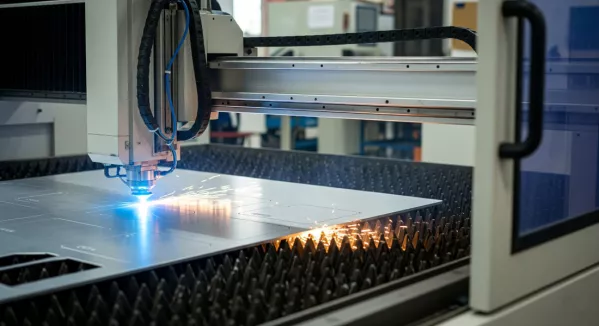
Aluminium is a material that perfectly meets the needs of modern industry. Its low weight, corrosion resistance, good thermal conductivity and recyclability make it widely used in the automotive industry, electronics, construction, machinery manufacturing and technical structures.
At the same time, the very properties that make aluminium such an attractive structural material also mean that its processing requires the right technology and expertise. Laser cutting is a good example. Achieving a precise part, a clean edge and high repeatability requires much more than simply directing a high-power laser beam at the sheet. The entire process matters – from the properties of the specific alloy and laser parameters to the assist gas and cutting strategy.
At first glance, cutting aluminium does not differ significantly from laser processing other metals. In practice, however, the material behaves in a specific way when exposed to concentrated energy.
One of the reasons is the high thermal conductivity of aluminium. The energy delivered by the laser beam is quickly dissipated beyond the immediate interaction zone. This means that the process parameters must be controlled with great precision.
Another challenge is aluminium’s ability to reflect radiation. This is particularly important with certain types of laser sources. This is why the development of modern fiber lasers has played such an important role in the industrial processing of aluminium.
The natural aluminium oxide layer that forms on the surface of the material must also be taken into account. It protects aluminium against corrosion, but has a much higher melting point than the metal underneath. As a result, initiating and stabilising the cutting process requires the correct selection of parameters.
One of the most important developments in laser metalworking has been the widespread adoption of fiber lasers.
Compared with older CO₂ solutions, they operate at a shorter wavelength, which is absorbed much more effectively by aluminium. This makes it possible to transfer energy to the material more efficiently, increase productivity and achieve high cutting quality.
High power density and excellent beam characteristics make it possible to produce both simple contours and complex geometries. Laser technology is therefore particularly well suited to the production of repeatable components based on CAD documentation.
When it comes to laser cutting, it is easy to assume that machine power is the most important factor. In reality, it is only one of many elements that affect the final result.
The process engineer must take into account factors such as:
These parameters are interdependent. Excessive speed may result in incomplete cutting or the formation of burrs. Cutting too slowly, on the other hand, increases the amount of energy delivered to a given area, which can reduce edge quality and increase the thermal impact on the component.
The aim is therefore not to use the “highest possible power”, but to find the right balance between speed, quality and process stability.
Assist gas is another important element in the laser cutting of aluminium. Its primary purpose is to effectively remove molten material from the cutting kerf.
In many applications, nitrogen is used because it allows the process to be carried out without significant oxidation of the cut edge. This is particularly important when surface quality matters in subsequent production stages.
Correctly selected gas pressure also helps reduce burr formation and improves process repeatability.
One of the most important criteria for assessing laser cutting is the quality of the resulting edge. Due to its ductility and the way it conducts heat, aluminium can be prone to burr formation.
This is why proper process configuration is important not only from an aesthetic perspective. The better the quality achieved directly after cutting, the less need there may be for additional finishing operations.
This is particularly important in series production. If hundreds or thousands of components require additional processing, even a small extra operation can begin to have a noticeable impact on lead times and total production costs.
Laser cutting is a thermal process, which means that the effect of temperature on the material is another factor that requires careful consideration.
For thin components or complex geometries, an inappropriate cutting sequence can lead to local stresses and deformation.
Therefore, not only the way an individual line is cut matters, but also the strategy used to produce the entire component. The sequence in which holes and contours are cut, as well as the arrangement of components on the sheet, can affect both process stability and the final geometry of the part.
Modern laser production therefore begins even before the machine is switched on – during process planning and preparation.
In industrial production, quality is extremely important, but efficient use of material is equally significant.
Aluminium is a valuable raw material, so the proper arrangement of components on the sheet has a direct impact on production economics. This is where nesting comes into play – the optimal arrangement of shapes to be cut.
Software can analyse component geometry and arrange parts in a way that minimises unused material. In large production runs, even a few percent improvement in sheet utilisation can translate into measurable savings.
One of the greatest advantages of laser cutting is the freedom it offers in designing shapes. There is no need to create a separate tool for each contour – the geometry is generated directly from the prepared program.
This makes it possible to produce, among other things:
Design changes can often be introduced directly in the documentation and program without the need to prepare a new set of conventional tools.
This is a major advantage in prototyping, short production runs and the manufacture of components that are frequently modified.
The combination of aluminium’s low weight and the capabilities of modern laser processing means that this technology is used across a wide range of industries.
In the automotive sector, aluminium helps reduce the weight of structures. In electronics, it is used for applications such as enclosures and heat-dissipating components. In construction, it is used to manufacture structural, finishing and façade elements. In the machinery industry, it is employed wherever low weight, adequate strength and corrosion resistance need to be combined.
Laser cutting makes it possible to transform an aluminium sheet into a precisely manufactured component that can then proceed to subsequent stages of production.
Modern production of metal components is increasingly rarely limited to a single operation. A laser-cut part may subsequently require bending, CNC machining, welding, grinding or surface preparation.
This is why viewing a component as part of the entire manufacturing process is becoming increasingly important.
Even at the cutting preparation stage, it is worth knowing what will happen to the component later. Proper hole placement, maintaining the required tolerances and correct edge preparation can simplify subsequent operations and reduce the risk of problems arising at later stages of production.
Producing one correct component is only the beginning. In industrial production, it is equally important to manufacture the next one – and every one after that – according to the same specifications.
Modern laser cutting is therefore a combination of machinery, software, properly selected parameters and process control.
Automation helps maintain stable production conditions, reduce the influence of random factors and efficiently produce both individual prototypes and larger series of components.
Laser cutting of aluminium is not a technology that stands still. Laser sources are becoming increasingly efficient, control systems more precise, and software better able to utilise data relating to both the material and the process.
Solutions that enable real-time monitoring of parameters and automatic responses to changing operating conditions are also continuing to develop.
The direction is clear: greater automation, higher repeatability, more efficient material utilisation and increasingly precise quality control.
Laser cutting of aluminium demonstrates that in modern metalworking, the final result is not determined by a single parameter or by machine power alone.
Knowledge of the material, the correct choice of technology, program preparation, assist gas, cutting strategy, component arrangement and final quality control all matter.
Only by combining these elements can the full potential of aluminium and modern laser systems be utilised. The result is fast, repeatable and precise production of components that can then move on to subsequent processing stages and find applications in even the most demanding industries.