poczta@prometalform.eu
+48 95 762 08 61
+48 95 762 08 61
Modern technologies of metal working
Laser beam cutting
Laser cutting of tubes and sections
Robotic welding
Sheet metal bending
+48 95 762 08 61
Laser beam cutting
Laser cutting of tubes and sections
Robotic welding
Sheet metal bending
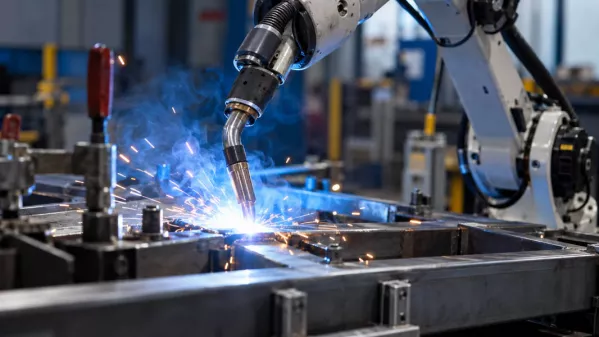
In modern industrial manufacturing, a good weld cannot be left to chance. Its geometry, penetration and repeatability must be maintained not only for a single component, but also across dozens, hundreds or even thousands of subsequent parts. This is precisely where robotic MAG and TIG welding processes become particularly important.
A welding robot does not get tired, does not slow down towards the end of a shift, and can repeatedly follow a programmed trajectory. However, this does not mean that simply using a robot automatically guarantees a perfect weld. Quality still depends on the entire process – from component preparation and tooling, through parameter selection, all the way to inspection of the finished joint.
One of the greatest advantages of robotic welding is the ability to translate a developed welding procedure into a repeatable set of movements and parameters.
In manual welding, the final result can be affected by even slight differences in torch guidance, travel speed or distance from the material. A robot can significantly reduce this variability. If the components are properly prepared and positioned, successive welds can be produced in a highly consistent manner.
This is particularly important in series production. Under such conditions, it is not only the quality of a single component that matters, but also the ability to maintain that quality throughout the entire batch.
MAG is one of the most commonly used welding methods in industry. The process uses a consumable wire electrode and shielding gas, while properly selected parameters enable efficient production of strong, durable joints.
Combining MAG welding with robotics is particularly beneficial wherever repeatable components and longer production runs are involved.
A robot can guide the torch along a programmed trajectory while maintaining the required speed, angle and electrical parameters. This makes it easier to achieve consistent weld shape and dimensions across successive components.
Robotic welding can also increase workstation productivity. Reducing downtime between individual operations and efficiently performing repetitive cycles allows production time to be used more effectively.
Even a highly advanced robotic workstation cannot compensate for every problem caused by improper process preparation.
Weld quality is influenced by factors including:
An incorrect combination of these factors can lead to issues such as porosity, insufficient penetration, undercut or improper weld geometry.
Robotics therefore does not eliminate the need for properly developed welding procedures. Instead, it makes it possible to repeat a correctly prepared process with a very high degree of accuracy.
TIG welding has a somewhat different character. The process uses a non-consumable tungsten electrode and an inert shielding gas. It is valued primarily for the high quality of welded joints, precise control of the weld pool and the ability to achieve an aesthetically pleasing weld surface.
Robotic TIG welding makes it possible to take even greater advantage of these benefits.
A consistent travel path and controlled distance between the electrode and the workpiece help maintain stable arc conditions. The ability to precisely control the amount of energy delivered to the material is particularly important when working with thinner components or materials susceptible to thermal distortion.
As a result, the risk of excessive heating and component deformation can be reduced while maintaining high weld surface quality.
In TIG welding, surface preparation is particularly important. Residues of oil, grease, oxides or other contaminants can negatively affect both the welding process and the quality of the joint.
Proper shielding gas coverage is equally important.
Even a precisely programmed robot cannot solve problems caused by contaminated material or incorrect gas flow. A robotic welding workstation should therefore be regarded as part of a larger production system in which component preparation, fixturing, welding and quality control form a single technological sequence.
This is one of the most important principles of robotic welding.
A robot can reproduce a programmed movement with exceptional precision, but if successive components arrive at the workstation in different positions or exhibit significant dimensional deviations, process stability will be compromised.
This is why not only the robot itself matters, but also the repeatability of preceding manufacturing operations.
Precise cutting, bending, CNC machining and appropriate welding fixtures make it easier to maintain the correct position of components. Only by combining these stages can the full potential of automation be achieved.
Welding is a thermal process, which means that material distortion remains one of its fundamental challenges.
The amount of heat introduced into the material depends, among other things, on electrical parameters and travel speed. Excessive heat input can increase the risk of distortion, while incorrectly selected parameters may result in insufficient penetration.
A robot enables the welding technologist to precisely program both process parameters and the sequence in which individual welds are made. With a properly developed welding procedure, this helps control how heat is distributed throughout the structure.
This is particularly important for components that must retain specific dimensions and geometry after welding.
Evaluating robotic welding solely in terms of welding speed would be a significant oversimplification.
Process stability is equally important.
If successive welds have consistent geometry and quality, the need for rework, additional grinding or re-welding can be reduced. Fewer non-conformities mean lower material consumption, shorter lead times and more predictable production planning.
In series production, even a small amount of time saved on each component can become significant when multiplied by hundreds or thousands of units.
Quite the opposite. In modern robotic welding, process monitoring is playing an increasingly important role.
Parameters such as electrical values, torch position, travel path and filler material feed conditions can be monitored. Advanced solutions also use seam-tracking systems and sensors capable of responding to deviations.
As a result, automation is no longer limited to simply executing a pre-programmed movement. Welding workstations are becoming part of an increasingly integrated manufacturing environment.
There is no single welding method that is best for every component.
MAG is particularly well suited to applications where productivity, speed and the manufacture of repeatable structures are key priorities.
TIG, on the other hand, is a natural choice for applications requiring a high degree of process control, excellent weld surface quality and precise work with more demanding materials or thinner components.
In practice, the choice of technology should be determined by the component design, material, quality requirements, production volume and subsequent manufacturing stages.
The greatest potential emerges when welding is not treated as an isolated stage of production.
A component must first be properly prepared – cut, machined or bent – then correctly positioned and joined, and finally the result must be verified.
At Pro Metal Form, robotic welding therefore forms part of a broader approach to the production of metal components and structures. Combining modern metalworking technologies with a controlled welding process makes it possible to manufacture both individual components and more complex projects.
A welding robot can provide impressive movement accuracy, but the true advantage of robotics only becomes apparent when the entire process has been properly planned.
A correctly prepared component, stable fixturing, properly selected MAG or TIG parameters, heat input control and verification of joint quality form a system in which every stage influences the next.
This is why modern robotic welding is about much more than automating torch movement. It is a way to build a repeatable, controlled and predictable manufacturing process in which quality can be maintained from the first component to the last part in the production run.