poczta@prometalform.eu
+48 95 762 08 61
+48 95 762 08 61
Modern technologies of metal working
Laser beam cutting
Laser cutting of tubes and sections
Robotic welding
Sheet metal bending
+48 95 762 08 61
Laser beam cutting
Laser cutting of tubes and sections
Robotic welding
Sheet metal bending
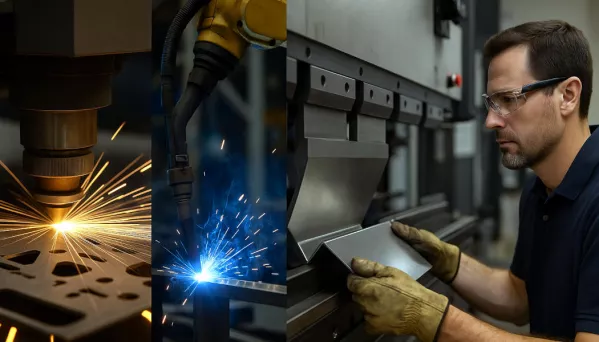
It all starts with a digital model. At the end, there is a physical component that can be installed in a machine, vehicle, device, or an entire structure. Between these two points lies the world of modern metalworking, where a laser beam cuts through steel, a computer-controlled press gives sheet metal the required geometry, and a robot performs successive welds along a programmed path.
Just a few decades ago, many of these processes required a tremendous amount of manual work. Today, manufacturing increasingly resembles a collaboration between people, machines, and software.
Let’s take a closer look at several technologies and phenomena that demonstrate just how fascinating modern metalworking can be.
Modern laser cutting does not begin when the laser beam is switched on. It starts much earlier – at the computer.
First, the component is designed. Then the manufacturing process must be planned, the appropriate parameters selected, and the parts arranged efficiently on the sheet.
In series production, the arrangement of parts can have enormous economic significance. Even a few percent improvement in material utilization, multiplied across hundreds or thousands of sheets, can make a real difference in material consumption.
That is why nesting has become such an important part of production preparation.
Laser cutting is often described simply as “cutting,” but physically, the process is very different from cutting material with a blade.
The energy of the laser beam is concentrated on a very small area. The material heats up rapidly and then melts or vaporizes. Process gas helps remove the molten material from the cutting kerf.
There is no conventional mechanical contact between a cutting blade and the workpiece.
This is one of the reasons why laser technology makes it possible to produce complex contours, small holes, and highly repeatable components.
For many years, CO₂ lasers played an important role in industry. However, the development of fiber laser sources opened up entirely new possibilities.
High energy efficiency, high cutting speeds for thin and medium-thickness sheets, and the ability to process a wide range of metals have made fiber lasers a standard solution in many modern manufacturing facilities.
Pro Metal Form uses laser technology for processing sheet metal as well as tubes and profiles. This makes it possible to prepare components that can subsequently move on to further production stages – bending, welding, or CNC machining.
And this is where another interesting chapter begins.
A flat piece of sheet metal may look unremarkable. Only carefully planned bends transform it into a three-dimensional structural component.
An equipment housing, bracket, frame component, panel, or machine part can be made from a single sheet that is first cut and then precisely formed.
This is why designing sheet metal components requires thinking several steps ahead.
It is necessary to know not only what shape the finished component should have, but also whether and how it can actually be manufactured.
One of the most characteristic phenomena encountered during bending is springback.
After the load is removed, the material partially returns toward its original geometry. The extent of this effect depends on factors such as the material grade, thickness, bending radius, and process parameters.
This means that in order to achieve a specific angle, it may sometimes be necessary to bend the material slightly beyond the desired position.
Modern CNC control systems and the experience of process engineers make it possible to account for this phenomenon when preparing the manufacturing process.
The machine therefore does much more than simply move up and down. Behind this seemingly straightforward operation lies the mathematics that describes material behavior.
Suppose a component requires six bends. Can they be performed in any order?
Not necessarily.
After the first or second bend, the geometry of the component may restrict its positioning for the next operation. Part of the workpiece may collide with the tooling, press beam, or another part of the machine.
This is why complex components require careful planning of the bending sequence.
Modern software can simulate the process and detect potential collisions before the first physical part is produced. In this sense, part of the manufacturing process is transferred into the virtual world.
First, engineers can check whether an idea will work on screen. Only then do they need to use actual material.
When prepared components need to be assembled into a larger structure, robotic welding may be one of the next stages.
In repetitive production, robotization offers particularly significant advantages.
An industrial robot can repeatedly follow a specified movement path while maintaining programmed parameters. With a properly prepared process, this makes it possible to achieve a high degree of repeatability from one production cycle to the next.
This is particularly important in larger production runs.
When a single structure needs to be produced, the flexibility of an experienced welder can be invaluable. But when hundreds or thousands of identical structures must be manufactured, the ability to repeat the same movement consistently becomes a major advantage of automation.
Robotization cannot compensate for a poorly designed component.
If the parts do not fit together properly, access to the weld is restricted, or the structure requires highly complex positioning, automation can become significantly more difficult.
This is why Design for Manufacturing is becoming increasingly important.
A good design takes into account not only the function of the finished product, but also how it will be manufactured.
Is the component easy to cut?
Can it be bent without collisions?
Will the welding equipment or robot have sufficient access?
Can the structure be securely positioned and clamped?
The answers to these questions can affect production costs just as much as the price of the material itself.
Not every component can be produced solely through cutting and bending. Parts requiring precise holes, surfaces, threads, grooves, or complex three-dimensional shapes may need to undergo CNC machining.
Here, metal meets the cutting tool in a very literal sense.
A milling cutter or turning tool removes successive portions of material until the required geometry is achieved.
Computer control makes it possible to precisely manage the tool path, movement speed, and other process parameters.
In everyday life, one millimeter seems like a very small unit. In engineering, it can be enormous.
Machine components must work together correctly. A shaft must fit its bearing, mounting holes must be positioned accurately, and mating surfaces must remain within specified tolerances.
Modern manufacturing is therefore not simply about producing a component that “looks like the drawing.”
What also matters is whether its actual dimensions fall within the specified tolerance range.
Customers often see only the finished product. One of the most important characteristics of the manufacturing process therefore remains invisible.
That characteristic is repeatability.
Producing one correct component may be relatively straightforward. The real challenge is producing the hundredth, thousandth, or ten-thousandth part while ensuring that it continues to meet all requirements.
This is why CNC control, automation, appropriate tooling, and process control are so important.
Temperature plays a role in almost every area of metalworking.
In laser cutting, heat is essential for separating the material. In welding, it enables a permanent joint to be created. During machining, heat is generated through friction and material deformation.
At the same time, excessive or unevenly distributed heat can lead to distortion and changes in material properties.
Modern technology is therefore not simply about delivering as much energy as possible. It is about controlling that energy – in the right place, at the right time, and in the right amount.
Materials processing is full of phenomena that may initially seem counterintuitive.
A stream of water mixed with abrasive particles and operating under extremely high pressure can cut through thick steel.
Shape-memory alloys can return to a previously programmed geometry after deformation when exposed to a change in temperature.
Ultrasound can assist in the machining of difficult-to-process materials.
Liquid nitrogen can be used for intensive cooling in certain manufacturing processes.
The further materials engineering develops, the clearer it becomes that the capabilities of metals extend far beyond what everyday experience might suggest.
For hundreds of years, the basic principle of manufacturing was relatively simple: take a larger piece of material and remove portions of it or change its shape.
Additive technologies reverse this logic.
A metal component can be built layer by layer based on a digital model. This makes it possible to create geometries that would be extremely difficult to manufacture using traditional methods.
Does this mean that 3D printing will replace milling machines, lathes, lasers, and presses?
A much more likely scenario is that these technologies will complement one another.
A component can be produced using additive manufacturing and then precisely finished using CNC machining. A structure can be laser-cut, bent, and welded. A single product may pass through several completely different manufacturing processes.
One of the most important changes taking place in industry today is the integration of machines with IT systems.
Machines can provide data on their operation, energy consumption, cycle times, and errors. This information can then be analyzed to optimize production and plan maintenance activities.
In the future, algorithms supporting parameter selection and process data analysis will also play an increasingly important role.
A factory is therefore no longer simply a collection of machines. It is becoming an environment in which the flow of information is just as important as the flow of materials.
Automation can create the impression that modern manufacturing is moving toward the complete elimination of human involvement.
In practice, it is primarily the human role that is changing.
Someone still needs to design the component, develop the manufacturing process, select the tools, prepare the program, assess quality, solve unusual problems, and decide which production method is the most appropriate.
A machine can perform a movement with exceptional repeatability. That does not mean, however, that it understands the purpose of the entire process.
Modern metalworking is therefore, above all, a combination of machine capabilities with human knowledge and experience.
The most fascinating aspect of metalworking is not any individual laser, robot, or CNC machine. It is the entire process.
Over the course of successive operations, a sheet of metal can be cut, formed, machined, and joined with other components. At every stage, its geometry becomes increasingly similar to what previously existed only as a digital model.
This is where technology meets engineering.
Modern metalworking is no longer simply about giving material the desired shape. It is the art of planning the entire process in such a way as to achieve the required quality, repeatability, and efficiency.
And as the development of lasers, automation, robotics, CNC systems, software, and new materials continues to accelerate, the boundaries of what can be created from metal continue to expand.